A women’s 1X is a plus size clothing label that often fits larger measurements than a standard XL. In many US size charts, 1X falls around women’s sizes 14W to 16W, but the exact range depends on the brand, garment, and cut.
Shopping for women’s clothes in the United States can feel confusing when one store uses XL and another uses 1X. Both labels may look close on a rack, yet the clothes can fit quite differently. A size 1X often comes from a plus size range made with different body measurements and garment proportions in mind.
The best way to find your size is to compare your bust, waist, and hip measurements with the chart for the exact brand. A number on a tag is only a starting point. Fabric stretch, garment shape, and the fit you want can all change which size works best.
A 1X is a clothing size used in many women‘s plus size collections. The letter X often marks an extended size range, while the number 1 identifies the first size in that range. It is not a fixed measurement shared by every clothing brand in the United States.
Many US size charts place 1X near sizes 14W or 16W. Some brands use different number ranges, so this comparison is only a guide. The size may also vary between tops, jeans, dresses, coats, and activewear.
The W in a label such as 16W often identifies a women’s plus size cut. It does not mean the same thing as the letter X in 1X. Brands may design plus size garments with different proportions, including more room through the waist, hips, sleeves, or upper arms.
A 1X label does not describe a person’s body shape or tell you how a garment will look. Two people who wear 1X may have different bust, waist, and hip measurements. One may need more room in the hips, while another may need more room across the shoulders.
Source: shunvogue.com
1X
A common label for the first size in a plus size clothing range.
XL
An extra-large label usually found in a standard alpha-size range, though some brands use overlapping measurements.
XXL or 2X
These labels may represent different size ranges. XXL can belong to a standard range, while 2X often belongs to a plus size range.
Is 1X Considered a Plus Size?
Yes, 1X is generally considered a plus size label in women’s clothing. It commonly appears at the start of a brand’s plus size range. However, the point at which a brand begins its plus range can differ.
Some stores offer XL in both standard and extended collections. Other stores move from XL directly into 1X or use numeric labels instead. Check the product’s size chart rather than assuming every store follows the same system.
What Does the X Stand For?
The X in XL, 1X, and 2X is part of an extended letter-size label. It does not provide a precise measurement by itself. The number before X helps identify a size within certain plus size ranges, but its meaning still depends on the brand’s chart.
What Size Is 1X in Women’s Numbers?
In many US women’s clothing charts, 1X is roughly comparable to numeric sizes 14W to 16W. This is a broad estimate, not a universal conversion. Some brands may associate 1X with a different number range, especially in fitted clothing or specialty collections.
The difference matters when you shop online. A size 16 in one store may fit like a 1X in another, while a size 16 in a third store may be cut closer to a standard XL. The garment’s intended fit also affects the result.
Use the following table as an initial guide. It shows common relationships between labels, not guaranteed measurements or exact conversions.
Source: allconversioncharts.com
Common Women’s Size Comparisons
The labels below show how US women’s alpha sizes and numeric sizes may relate. Always check the chart attached to the item you plan to buy.
XL
Often falls near standard numeric sizes 16 to 18, depending on the brand and clothing type.
1X
Often falls near plus size numeric sizes 14W to 16W, though some brands use a broader or different range.
XXL
May overlap with XL or 1X in measurements, but the label alone does not show how the garment is cut.
2X
Usually identifies a size above 1X in a plus size range, but its measurements must be checked separately.
Why There Is No Exact Conversion
US clothing sizes are not based on one universal measurement system. Brands set their own size charts and may use different body measurements when designing a garment. This means two items with the same size label can have different bust, waist, and hip measurements.
A loose cotton shirt and a fitted denim dress also need different amounts of room to fit as intended. For that reason, a conversion table should help narrow your options, not replace the manufacturer’s chart.
1X vs XL: What Is the Difference?
A women’s 1X and XL can overlap in size, but they do not always share the same cut. XL often belongs to a standard size range, while 1X often belongs to a plus size range. That difference can affect how much room a garment has through the bust, waist, hips, upper arms, and torso.
For example, a standard XL blouse may fit well across the shoulders but feel tight at the hips. A 1X blouse from a plus size range may offer a different balance of room. This is not true for every brand, so the actual measurements matter more than the label.
Neither label is automatically larger in every measurement. One XL garment could have a wider bust than a particular 1X garment, depending on the design and brand. Compare the charts and consider the shape of the clothing before choosing.
Source: askdifference.com
Standard XL
May suit shoppers whose measurements align with a brand’s standard size chart and the garment’s intended cut.
Plus size 1X
May suit shoppers who need a different balance of room through the bust, waist, hips, or arms.
Best way to compare
Check the listed body measurements and fit notes for both items instead of relying on the label alone.
Should You Buy XL or 1X?
Start with your body measurements and the garment’s chart. If your bust and waist fall within the XL range but your hips fit the 1X range, look at the garment shape before choosing. A relaxed top may work in XL, while fitted trousers may need more hip room.
Read notes such as slim fit, relaxed fit, stretch fabric, or oversized. These terms help explain how much room the maker intended the clothing to have. When the chart is unclear, review the store’s return policy before ordering.
How to Measure Yourself for a 1X Size
Measuring your body is one of the most useful ways to choose a women’s 1X. You only need a flexible measuring tape, a mirror if available, and a few minutes. Take the measurements over light clothing or close-fitting undergarments so thick fabric does not add extra bulk.
Keep the tape level and close to your body without pulling it tight. Stand in a relaxed position and breathe normally. If possible, ask someone to help measure your back and hips so the tape stays straight.
Source: shunvogue.com
Bust
Wrap the tape around the fullest part of your bust. Keep it level across your back, and do not pull it tight.
Waist
Measure around your natural waist, often the area between the ribs and hips where your torso bends. Do not suck in your stomach.
Hips
Measure around the fullest part of your hips and seat. Check that the tape is level all the way around.
Inseam
For pants, measure from the crotch seam down to the ankle or the length you want. Compare this with the garment’s inseam chart.
How to Use Your Measurements
Write down your bust, waist, and hip measurements in inches if you are shopping from US size charts. Compare each one with the brand’s body measurement chart. If the brand provides only garment measurements, remember that these describe the item itself rather than your body.
When one measurement falls into a different size range from the others, consider which part of your body needs the most room in that garment. For a fitted skirt, hip measurements may matter most. For a button-front shirt, bust and shoulder fit may matter more.
Do not assume that you must choose the same size for every item. It is normal to wear one size in a loose sweater and another in jeans. Different fabrics and cuts can change the fit.
Body Measurements vs. Garment Measurements
A body measurement describes the size of your body at a given point. A garment measurement describes the finished clothing. A shirt with a 44-inch bust measurement does not necessarily fit a person whose bust measures 44 inches, because the garment may need extra room for movement and comfort.
Look for chart labels such as body bust, garment bust, waist, hip, and finished length. If the chart does not say which type of measurement it uses, check the product details or ask the seller before buying.
What Measurements Usually Fit Women’s 1X?
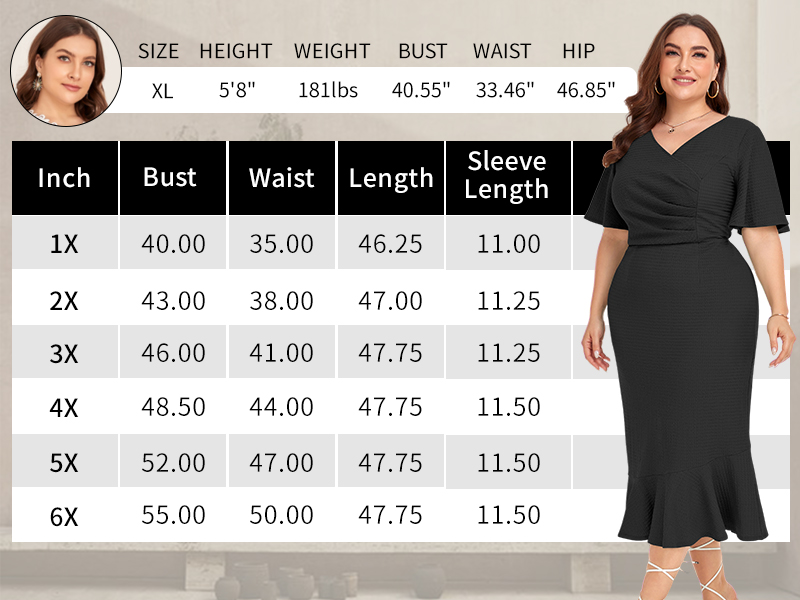
There is no single set of bust, waist, and hip measurements that fits every women’s 1X. Brands may use different body measurement ranges, and their charts can vary by product category. A 1X dress, for instance, may have a different cut from a 1X pair of leggings.
Use the measurements listed by the brand as your main guide. If a chart gives a range, compare your own measurements with the full range rather than just its smallest number. If your measurements sit near a boundary, check the fabric stretch and fit notes before making a choice.
Avoid relying on a size chart copied from a different store. A chart from one brand cannot confirm the correct size in another brand, even if both use the label 1X.
Source: shunvogue.com
For tops
Check bust, shoulder, sleeve, and upper-arm room. A fitted top may need a closer measurement match than a loose tee.
For pants
Check waist, hips, rise, and inseam. The rise affects where the waistband sits on your body.
For dresses
Check bust, waist, hips, and garment length. A fitted dress may need room at more than one point.
For coats
Leave enough room for the layers you plan to wear underneath. Sleeve length and shoulder movement also matter.
What If Your Measurements Fall Between Sizes?
Choose based on the fit you need in that garment. For a woven shirt with little stretch, the larger size may give you more room to move. For stretchy leggings, the brand’s fit advice and fabric details may help you decide whether the smaller size can work.
A size chart boundary is not a rule about your body. It is a guide to how a brand designed its clothing. If returns are allowed, ordering two nearby sizes may help when the fit is uncertain, provided you can manage the cost and return terms.
How 1X Fits in Different Types of Clothing
A 1X label does not guarantee the same fit across all clothing types. Each garment is shaped for a different purpose, and the fabric changes how it sits on the body. A size that feels comfortable in a loose T-shirt may feel restrictive in a fitted jacket.
Before buying, consider the fabric, stretch, seams, and intended fit. Product photos can show the overall style, but they cannot confirm the exact fit on your body. The written chart and garment details are more useful for making a size choice.
Source: shunvogue.com
Tops and T-Shirts
For tops, bust and shoulder measurements are useful starting points. A relaxed cotton T-shirt may offer more room than a fitted knit top with the same label. Check the sleeve opening and upper-arm room if these areas tend to feel tight.
Jeans and Pants
Jeans need a good match at the waist and hips, along with the right rise and leg length. A high-rise pair sits higher on the torso than a low-rise pair. Denim with stretch may feel different from rigid denim, even when both carry a 1X label.
Look for the actual waist and hip chart when available. Also check whether the waist is designed to sit at the natural waist or below it. The number printed on a tag cannot tell you where the waistband will land.
Dresses and Skirts
Dresses often need a balance between bust, waist, and hip room. An A-line dress may provide more space through the lower half than a fitted sheath dress. A wrap dress can offer some adjustment, but its coverage and shape still depend on the cut.
For skirts, compare the waist and hip measurements, then check the length. A skirt that fits at the waist may still pull across the hips if its cut is narrow.
Bras, Sleepwear, and Activewear
Bra sizing uses band and cup measurements, so 1X is not a substitute for a bra size. Sleepwear and activewear may use alpha sizes, but their stretch and support needs can differ. Check whether the item is meant to fit loosely, closely, or with compression.
For activewear, follow the brand’s guidance for stretch and support. For sleepwear, consider whether you prefer extra room around the waist and legs. One label cannot account for every comfort preference.
Common Mistakes When Shopping for 1X Clothing
The most common sizing mistake is treating every brand’s 1X as the same size. That can lead to clothes that pull, sag, or feel uncomfortable. A quick check of the chart can help you avoid many of these problems.
Pay attention to the garment itself rather than judging fit by the tag alone. The right choice should allow you to sit, reach, walk, and move without unwanted pulling or tightness.
Source: shunvogue.com
Using another brand’s chart
A chart from a different store may use other measurements. Use the chart linked to the item you are buying.
Ignoring fabric stretch
Stretch fabric may fit differently from a woven fabric with little give. Read the fabric description and fit notes.
Choosing only by the number
A numeric size and an alpha size do not convert exactly across all brands. Compare your measurements first.
Skipping the return policy
Check whether the seller accepts returns or exchanges before ordering a size that you have not tried.
Expecting every body area to match one size
Your bust, waist, and hips may fall into different ranges. Choose the size and cut that suit the garment’s main fit needs.
Signs That a 1X Garment Does Not Fit Well
A garment may be too small if buttons pull apart, seams strain, pockets gape, or you cannot move comfortably. A garment may be too large if the shoulders drop far beyond their intended position, the waist slips, or the clothing bunches in places where it should sit smoothly.
Some designs are meant to be loose or oversized, so extra room is not always a problem. Compare the fit with the product description and check how the item feels during normal movement. Comfort and intended design matter more than a rigid rule about how clothes should look.
Frequently Asked Questions
Q
Is women’s 1X the same as size 16?
Women’s 1X often falls near size 14W or 16W in some US clothing charts, but it is not always the same as size 16. The exact relationship depends on the brand, garment, and cut. Check the product’s size chart for the best match.
Q
Is 1X bigger than XL?
A 1X may have more room than a standard XL in some areas because it often belongs to a plus size range. However, the two labels can overlap. Compare the bust, waist, and hip measurements instead of assuming one label is always larger.
Q
Is 1X the same as XXL or 2X?
No, not in every brand. XXL may be part of a standard alpha-size range, while 2X often follows 1X in a plus size range. Some measurements may overlap, so use the brand’s own chart to compare them.
Q
What size should I buy if I wear 1X?
Start with 1X, then compare your body measurements with the chart for the item. A different size may fit better in a brand with a different cut or in a garment with little stretch. Read the fit notes and return terms before ordering.
Q
Can I wear 1X if I usually wear XL?
Yes. You may find that 1X offers a more comfortable fit in some styles, while XL works better in others. Compare the actual measurements and consider where you want more room. It is normal to wear different sizes across brands and clothing types.
Q
How do I know if 1X will fit when shopping online?
Measure your bust, waist, and hips, then compare those numbers with the brand’s chart. Check whether the listed figures refer to body measurements or finished garment measurements. Read the fabric and fit details, and confirm the return policy if the size is uncertain.
✦ Wrapping Up
Conclusion
A women’s 1X is generally a plus size clothing label that may fall near sizes 14W to 16W in some US charts. It can overlap with XL or XXL, but the labels do not have one fixed meaning across all brands. The garment’s cut, fabric, and intended fit all affect how it feels.
For the best fit, measure your bust, waist, and hips before shopping. Use the exact brand chart and pay attention to garment details, especially for jeans, dresses, and fitted tops. A size label is a guide, not a rule about your body.
💡 Key Takeaway
Measure your bust, waist, and hips in inches, then compare all three with the size chart for the exact item before choosing 1X.