What is average women’s shoe size? Learn the U.S. range, size 8.5 vs. 9, height links, foot changes, and how to find your true fit.
What is average women’s shoe size? In the U.S., it’s often around 8.5 to 9, but that number can’t tell you what will fit your feet. I’ve found that height, age, foot width, and brand sizing can shift the right size. Let’s look at the real numbers, key factors, and simple ways to measure your feet.
What Is Average Women’s Shoe Size?
If you’re wondering what is average women’s shoe size, the short answer is about U.S. women’s 8.5 to 9. That range gets quoted often, but there’s no official national shoe-size census, so it’s better used as a rough guide than a rule.
Your own size can differ a lot based on height, genetics, foot width, age, pregnancy, and the brand you buy. A size 9 isn’t unusually large, and a size 6 isn’t unusually small.
Key Takeaways
- The commonly cited U.S. average is 8.5 to 9.
- Size 8.5 and size 9 are both common shopping sizes.
- Taller women often have longer feet, but height can’t predict shoe size exactly.
- Feet can become wider or flatter with age and after pregnancy.
- Shoe size varies between brands and countries.
- Your measured foot size matters more than the population average.
What is average women’s shoe size in the U.S.?
For adult women in the United States, the commonly cited average falls around U.S. size 8.5 to 9. Healthline notes that there are no official U.S. statistics establishing one exact national average, so the number should be treated as an estimate rather than a hard fact.
That distinction matters when you’re shopping. I wouldn’t use size 8.5 or 9 as a target just because it’s called “average.” A shoe should fit your foot, not the average woman’s foot.
| Common U.S. size | How to view it |
|---|---|
| 5–6 | Smaller than the commonly cited average |
| 6.5–7.5 | Below the commonly cited average |
| 8–8.5 | Near the common range |
| 9 | Near the common range |
| 9.5–11 | Above the common range |
| 11+ | Larger than the common range |
The ranges above are only useful for context. They don’t tell you whether a shoe will fit.
A 2020 study based on about 1.2 million 3D foot scans found wide variation in foot dimensions across regions and sexes. The researchers also found enough variation within groups to support offering multiple widths for proper fit.
[EXTERNAL LINK: 1.2 million foot-scan study]
How common are size 8.5 and size 9?
Size 8.5 and size 9 sit right around the commonly reported U.S. average, which is why you’ll see both numbers used when people discuss the most common women’s shoe sizes.
There’s a good reason the answer isn’t always one clean number. Shoe-size data can come from different populations, years, stores, or surveys. A retailer’s sales data may show a different “most common” size than a medical study measuring actual feet.
I also wouldn’t treat a half-size difference as meaningful in everyday life. A woman who wears 8.5 in one brand may need a 9 in another.
Fit changes with the shoe itself. A narrow pump, cushioned running shoe, leather loafer, and soft slipper can all feel different even when the size printed inside looks the same.
The better question is whether the shoe gives your toes room, holds your heel well, and matches your foot width.
That becomes even more important because research on women’s footwear has found that many women have worn shoes smaller than their actual feet. In a study of 356 women, most wore shoes that were too small, and many reported foot pain or deformity.
How does height affect women’s shoe size?
Height and foot length are related, so taller women often have longer feet. Your feet provide a base for your body, and larger body size often goes with larger foot dimensions.
But height doesn’t give you a reliable shoe-size answer.
For example, two women who are both 5 feet 5 inches tall could easily wear different sizes. One might wear a 7.5 while another wears a 9.5. Genetics, bone structure, foot shape, and body proportions all play a role.
Some published summaries give broad height-based shoe-size ranges, but there isn’t an official U.S. chart that can accurately predict a woman’s shoe size from height alone.
Typical size ranges by height
| Adult height | Rough shoe-size range sometimes reported |
|---|---|
| 4’9″–5’3″ | 5–8.5 |
| 5’4″–5’7″ | 6.5–10 |
| 5’8″–6′ or taller | 9–15 |
These ranges are broad on purpose. They show overlap, not a formula.
A study examining foot and shoe dimensions also found a significant relationship between stature and foot length in women, but the relationship wasn’t strong enough to make height a substitute for measuring the foot.
So if you’re 5’2″ and wear a size 9, nothing is wrong. Your shoe size doesn’t have to “match” your height.
Does age change the average women’s shoe size?
Your feet can change as you age, even after your bones have stopped growing. The change is often more about shape, width, arch height, and how the foot spreads under load.
This surprised me when I first looked into shoe sizing. Many people assume that once they reach adulthood, their shoe size is locked in forever.
It isn’t always.
An older study of 356 women found that many participants had increased their shoe size since age 20. The researchers also found that many women wore shoes smaller than their measured feet.
Age-related changes can include:
- A flatter arch
- A wider forefoot
- Changes in heel width
- Less snug shoe fit
- More sensitivity to pressure
- A need for a wider shoe
Your foot may not suddenly jump from an 8 to a 10. Instead, the shoe that once felt fine may slowly start to feel tight.
That’s one reason I’d measure your feet again if old shoes suddenly feel cramped.
[INTERNAL LINK: how to measure your shoe size at home]
What is the average women’s shoe size by country?
Shoe sizes don’t use one global system. A U.S. women’s 8.5 isn’t written as 8.5 everywhere.
The commonly reported averages also vary by country, although international comparisons are not always based on the same kind of data. Healthline lists examples such as a UK size 6, roughly equivalent to a U.S. women’s 8.5, and a Japanese size 23, roughly equivalent to a U.S. women’s 6.
U.S., UK, and EU size conversions
| U.S. women’s | Approx. UK | Approx. EU |
|---|---|---|
| 6 | 4 | 36–37 |
| 7 | 5 | 37–38 |
| 8 | 6 | 38–39 |
| 8.5 | 6.5 | 39 |
| 9 | 7 | 40 |
| 10 | 8 | 41–42 |
| 11 | 9 | 42–43 |
Treat this as a shopping guide, not a perfect conversion chart. Brands can use slightly different lasts and sizing methods.
When I shop across countries, I check the brand’s own chart first. That small step can save a surprisingly annoying return.
[INTERNAL LINK: women’s shoe size conversion chart]
Is a size 9 large for a woman?
No. A women’s U.S. size 9 is within the commonly cited U.S. average range of 8.5 to 9.
Even outside that range, there’s no useful reason to label a shoe size as “too large” or “too small” based on averages alone.
A size 9 woman may have long, slim feet. Another woman with the same size may have a wide forefoot. A third may need a 9.5 in a running shoe but an 8.5 in a sandal.
The printed number tells only part of the story.
I’d pay more attention to how the shoe feels after walking for 20 or 30 minutes. If your toes hit the front, your little toe rubs the side, or your heel slips with every step, the number on the box isn’t helping much.
Your feet don’t need to be average. They need to be comfortable and well supported.
Can pregnancy and weight change women’s shoe size?
Pregnancy can change foot shape and, for some women, shoe size. Research has found changes in foot posture during pregnancy, while clinical sources also note that some women experience feet becoming flatter or wider.
The change isn’t the same for everyone.
Pregnancy places extra load on the feet, and hormonal changes can affect ligaments and foot structure. Some changes may remain after pregnancy.
Weight changes can also affect how the foot bears load. That doesn’t mean every weight change will increase shoe size, but it can change how a familiar shoe feels.
If your old shoes suddenly feel tight across the ball of the foot, don’t assume you simply need to “break them in.”
Try comparing:
- Your old shoe size.
- Your current foot length.
- Your current foot width.
- The brand’s size chart.
- A wider shoe if the length still feels right.
A longer shoe isn’t always the answer to a wider foot.
Why might your shoe size differ from the average?
The average tells you what a population may look like. It doesn’t tell you what your feet should look like.
Genetics can affect foot length and width. Height, age, body structure, activity, pregnancy, and previous footwear choices can also affect fit.
Foot shape matters just as much.
A large 3D foot-scan study found substantial variation in foot measurements even within the same broad groups. The authors concluded that footwear needs more than one width to provide a good fit for most customers.
Length is only one part of shoe fit
Consider these common differences:
- Wide forefoot: You may need a wide shoe even if the length is average.
- High instep: Some slip-on shoes may feel tight across the top.
- Flat arch: Your foot may spread more when standing.
- Narrow heel: A shoe can fit your toes but slip at the back.
- Different foot lengths: One foot may be slightly larger.
That last point is especially common. You don’t need both feet to be identical.
The older women’s shoe survey found that many participants wore shoes smaller than their actual feet, which is a good reminder that shoe labels can hide a fit problem.
[EXTERNAL LINK: American Orthopaedic Foot & Ankle Society women’s shoe survey]
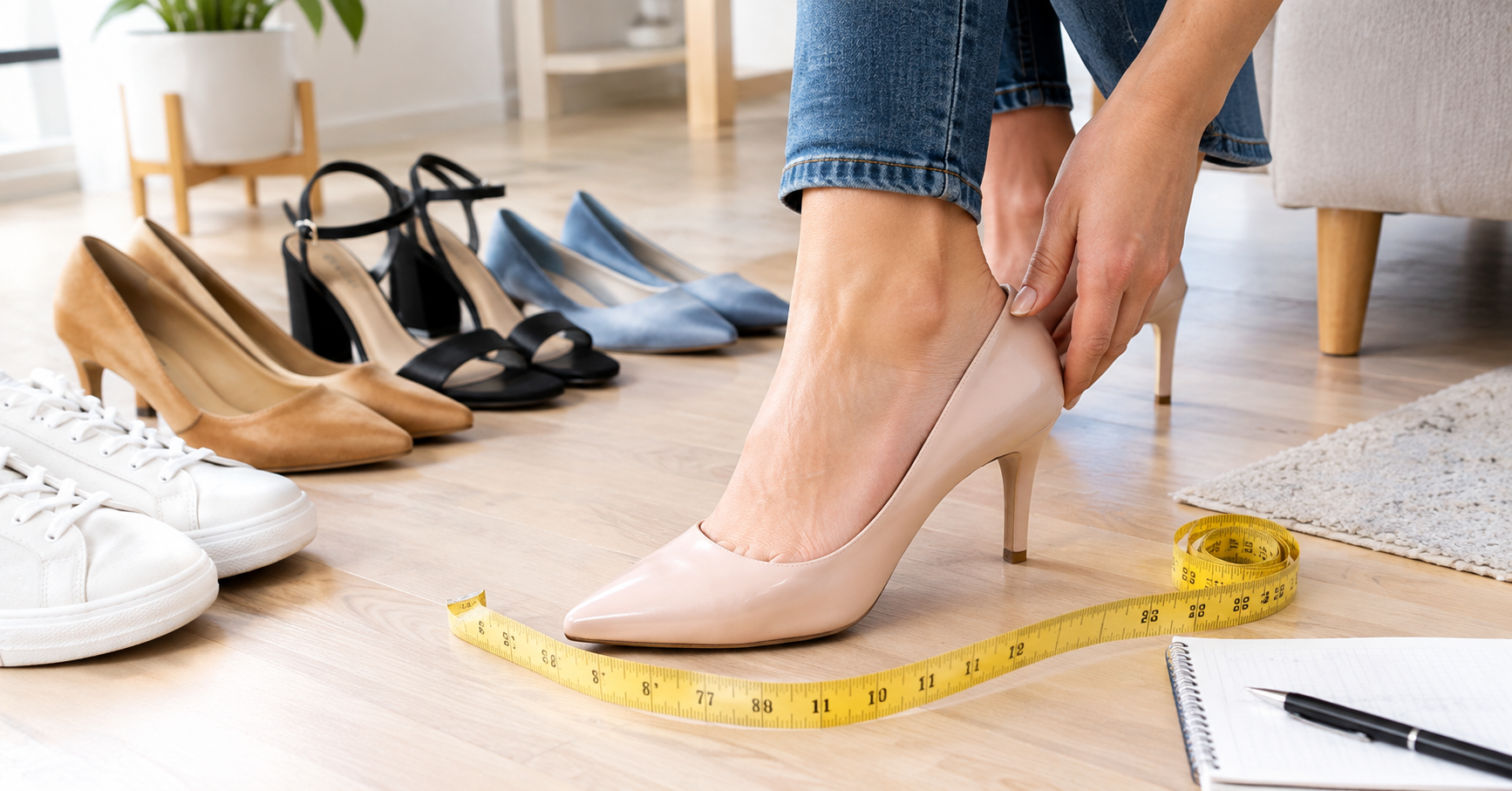
How can you measure your actual shoe size at home?
You don’t need to guess your size from your height or compare yourself with friends. A basic home measurement can give you a much better starting point.
Measure your feet while standing, because your foot carries body weight and can spread slightly.
Simple home method
- Put a sheet of paper on a hard floor.
- Wear the socks you normally use with the shoes.
- Stand with one foot flat on the paper.
- Mark the back of your heel and the longest toe.
- Measure the distance between those points.
- Measure the widest part of your foot.
- Repeat with the other foot.
- Use the larger foot when checking a size chart.
Don’t measure only one foot. Research on foot shape has shown meaningful variation between individual feet and across populations.
Measure later in the day if you’re buying everyday walking shoes. Your feet can feel different after hours of standing and walking than they do first thing in the morning.
Then compare your measurements with the specific brand’s chart.
[INTERNAL LINK: how to measure women’s shoe size at home]
Is average shoe size more important than proper fit?
Proper fit matters much more.
I’d rather wear a size 10 that feels right than squeeze into an 8.5 because someone called it average. A shoe should give your toes enough space to move while keeping your heel reasonably secure.
A basic fit check can save you from many bad buys.
| Fit check | What you want |
|---|---|
| Toe room | Toes should not press the front |
| Width | No painful side pressure |
| Heel | Minimal slipping |
| Midfoot | Secure without harsh pressure |
| Arch | Comfortable support |
| Walking test | No rubbing or sharp pressure |
Clinical guidance on shoe fitting stresses proper evaluation and notes that poorly fitting footwear can worsen foot problems.
If you already have foot pain, deformity, or another foot concern, professional fitting or advice from a podiatrist can make more sense than guessing from a size chart.
The number inside your shoe is useful. It just isn’t the whole fit.
What shoe size should you buy online?
Online shopping makes shoe sizing harder because you can’t stand in the shoe before paying.
My first move would be to measure both feet. My second would be to check the brand’s own chart. My third would be to read recent reviews for comments about narrow, wide, short, or long fit.
Don’t rely on one customer saying, “Runs big.”
Look for repeated patterns.
Use this online buying checklist
- Measure both feet.
- Check the brand’s size chart.
- Check whether the shoe comes in different widths.
- Read reviews about length and width.
- Compare the shoe with a pair you already own.
- Check the return window before ordering.
- Keep the shoe unworn indoors until you’re sure it fits.
A study using 3D foot scans found enough variation in foot dimensions that multiple widths can be important for proper fitting.
That’s why two women can both be a U.S. size 9 but need completely different shoes.
If a shoe is sold only in standard width, don’t assume going up one full size will solve a width problem. It may give you more length without giving your forefoot the shape it needs.
Average women’s shoe size: the real takeaway
So, what is average women’s shoe size? In the U.S., the commonly cited range is about 8.5 to 9, but there’s no official national figure that makes one size the universal answer.
The useful part isn’t deciding whether your feet are average. It’s knowing where you fall and why.
Use the average as context. Then measure your feet, check length and width, compare the brand’s chart, and pay attention to how the shoe feels when you walk.
A size 6, 8.5, 9, 11, or 12 can all be normal. Your best shoe size is the one that gives your actual feet enough room and support.
I’ve learned that shoe numbers can make sizing seem more exact than it really is. Your feet are living, changing parts of your body, not fixed numbers on a box. If I’m choosing a pair, I trust a good fit over an “average” label every time. Even the sound of my keyboard can’t make a tight shoe feel better after a long walk.
Frequently asked questions
What is the average women’s shoe size in the U.S.?
The commonly cited U.S. average is about 8.5 to 9, but there’s no official national shoe-sizeF figure. Learn more about U.S. shoe sizing.
Is size 8.5 a common women’s shoe size?
Yes. Size 8.5 falls within the commonly cited U.S. average range for adult women. Learn more about finding the right fit.
Is a women’s size 9 considered large?
No. Size 9 is within the commonly cited U.S. average range and isn’t unusually large. Learn more about women’s shoe sizes.
Does height affect women’s shoe size?
Height and foot length are linked, but height alone can’t predict your shoe size because foot shape varies. Learn more about measuring feet.
Do women’s feet get bigger with age?
Feet can become longer, wider, or flatter with age even after bone growth stops. Learn more about age-related shoe fit.
What is the most common women’s shoe size worldwide?
There isn’t one reliable worldwide average because countries use different sizing systems and populations vary. Learn more about global shoe sizing.