In US shoe sizing, a common starting point is to subtract about 1.5 sizes from a women’s size to estimate the equivalent big kids’ size. For example, a women’s size 8 may correspond to a big kids’ size 6.5. This is a general guide, not a universal rule, because shoe brands and styles can fit differently.
Shopping for shoes in the United States can get confusing when women’s and children’s size charts use different numbers. A pair of youth sneakers may look like the same shoe as an adult pair, yet the size printed on the box can be quite different. The good news is that a simple conversion rule can help you narrow down your options.
When you compare womens and childrens shoe sizes, start with the US size system and the type of children’s shoe. Big kids’ sizes are the most useful for this task, since they overlap with many adult sizes. Toddler and little kids’ sizes cover smaller feet and follow different size ranges. The best match still depends on the brand, shoe shape, foot width, and the way the shoe is meant to fit.
This guide explains the common conversion rule, shows a practical comparison chart, and walks you through measuring your feet at home. It also covers the limits of size charts, the difference between youth and adult shoes, and the checks that can help you avoid buying a pair that is too tight or too loose.
The simplest way to compare women’s and children’s shoe sizes in the United States is to use a conversion estimate, then check the brand’s own size chart. For many common sneaker lines, subtracting about 1.5 from the women’s size gives a useful starting point for big kids’ shoes.
For example, if you wear a women’s US size 8, you can begin by looking at a big kids’ US size 6.5. That does not guarantee the two shoes will fit the same. One may have a narrower toe box, a different heel shape, or less room across the top of the foot.
Think of the conversion as a way to narrow your search, not as a final fitting test. If the brand uses a different conversion method or does not make half sizes in its youth range, use the official chart and compare foot length in inches or centimeters.
Source: sizechartwomen.com
Start with your women’s size
Use the US women’s size you normally wear in a similar type of shoe, such as a sneaker or casual shoe.
Subtract about 1.5 sizes
Use this common estimate to identify a likely big kids’ size, while keeping in mind that some brands use different conversions.
Check the exact brand
Compare the size chart and fit notes for the model you want to buy. Do not rely on a chart from a different brand as the final authority.
Test the fit
Check toe room, width, heel hold, and comfort before wearing the shoes for a long period.
The Basic Conversion Formula
A commonly used estimate for US big kids’ shoes is: big kids’ size equals women’s size minus 1.5. To estimate the women’s equivalent of a big kids’ size, add about 1.5 instead.
For example, a big kids’ size 5.5 may be close to a women’s size 7. This is only a starting estimate. Some brands and shoe models use different size relationships, so a matching number does not prove that the shoes have the same length or fit.
Women’s to big kids’
Women’s 8 minus 1.5 gives an estimated big kids’ size of 6.5.
Big kids’ to women’s
Big kids’ 6 plus 1.5 gives an estimated women’s size of 7.5.
Women’s to Children’s Shoe Size Conversion Chart
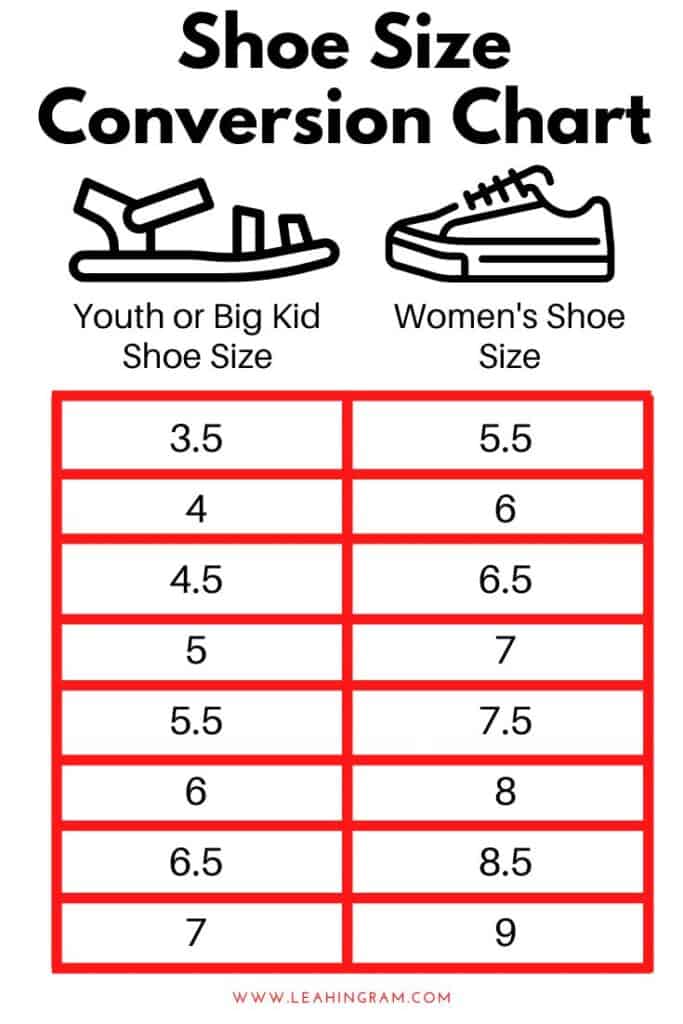
The chart below shows approximate US size matches based on the common 1.5-size difference. Use it to compare women’s sizes with big kids’ sizes before checking a manufacturer’s chart.
The values are estimates rather than official measurements for every brand. Children’s size labels, available half sizes, and actual shoe dimensions vary by maker and style. If the size you need falls between two options, measure your feet and review the brand’s instructions before choosing.
Source: hip2save.com
Women’s US 5
Estimated big kids’ US 3.5.
Women’s US 5.5
Estimated big kids’ US 4.
Women’s US 6
Estimated big kids’ US 4.5.
Women’s US 6.5
Estimated big kids’ US 5.
Women’s US 7
Estimated big kids’ US 5.5.
Women’s US 7.5
Estimated big kids’ US 6.
Women’s US 8
Estimated big kids’ US 6.5.
Women’s US 8.5
Estimated big kids’ US 7.
Women’s US 9
Estimated big kids’ US 7.5.
Women’s US 9.5
Estimated big kids’ US 8.
Women’s US 10
Estimated big kids’ US 8.5.
How to Read the Chart Correctly
The chart compares size labels, not the exact inside length of each shoe. Two pairs marked US women’s 8 may fit differently, even when they come from the same company. A running shoe, a flat, and a leather boot can each have a different fit.
Use the estimate to find a size range, then compare the measurements listed by the seller or brand. If a manufacturer lists foot length for each size, use that information as well. Measurements can help you make a better choice than a conversion number alone.
When the chart matches your usual size
Try the estimated youth size if the brand confirms the conversion and the shoe is offered in that size.
When the chart gives a different result
Follow the brand’s current size chart for that model rather than forcing the common formula to fit.
When half sizes are unavailable
Compare the brand’s foot-length guidance and assess whether the next size up or down gives a secure, comfortable fit.
Understanding Toddler, Little Kids, and Big Kids Sizes
Children’s shoes are usually divided into toddler, little kids’, and big kids’ or youth ranges. The exact age and size cutoffs depend on the manufacturer. For adult shoppers comparing sizes, the big kids’ range is generally the most relevant because it can overlap with women’s shoe sizes.
The terms can be confusing because a store may label all children’s shoes as kids’ shoes. However, a toddler size and a big kids’ size are not interchangeable. A toddler size 6, for example, is not a suitable substitute for a big kids’ size 6 or a women’s size 7.5 simply because the number is the same.
Always confirm which size range the store is showing. Online filters may separate baby, toddler, little kids, and big kids, while other shops group them under a broad children’s category.
Source: allconversioncharts.com
Toddler sizes
These are designed for very young children and small feet. They do not follow the adult-to-youth comparison in the chart.
Little kids’ sizes
These cover the next stage of children’s footwear. The sizes are generally smaller than the big kids’ range.
Big kids’ or youth sizes
These are the sizes most often compared with women’s sizes. Many casual and athletic shoe lines offer a range that overlaps with adult sizing.
Why the Size Category Matters
A size number has meaning only within its sizing system. A US big kids’ 6 and a US toddler 6 describe very different shoe sizes. A store’s category label is therefore just as important as the number on the box.
If you are buying online, open the full product page rather than relying on the search result alone. Look for the selected size category, the brand’s conversion chart, and any notes about whether the sizes are listed for adults or youth.
Check the label
Confirm that the size is listed as big kids, youth, or grade school if that is the range you need.
Check the region
Make sure the chart uses US sizes rather than UK or European sizing.
Are Women’s and Children’s Shoes the Same Size?
A women’s shoe and a big kids’ shoe can have similar lengths, but the two pairs are not always built to the same shape. Size conversion is about finding a likely equivalent, not proving that every feature matches.
Adult and youth shoes may differ in width, heel shape, arch support, cushioning, materials, and available size options. These differences vary by manufacturer and model. Some youth shoes share much of their design with adult versions, while others have a distinct fit or construction.
For this reason, a youth shoe can work well for an adult whose feet fit its shape and size range. Another person with the same foot length may prefer the adult version because it offers a better width or a more comfortable fit.
Source: sizechartwomen.com
Length
The converted sizes may have a similar intended length, but check the brand’s foot-length chart when possible.
Width
A youth shoe may feel narrower or otherwise different from the adult model. Check width options and try the shoe if possible.
Support and cushioning
The amount and type of cushioning or support depend on the specific shoe, not just the size label.
Available designs
Some colors and styles appear in both adult and youth ranges, but the full selection may differ.
When a Youth Shoe May Be a Good Fit for an Adult
A big kids’ shoe may be suitable when its length, width, and overall shape match the wearer’s feet. It can be a practical option for casual use if the shoe feels secure and does not cause pressure or slipping.
The fit matters more than the category printed on the box. For long walks, running, standing for work, or other demanding activities, pay close attention to cushioning, stability, and the manufacturer’s intended use. Do not choose a youth model based on the converted number alone.
Casual wear
Check for a secure heel, comfortable toe room, and no tight spots across the foot.
Sports and running
Choose a model suited to the activity and make sure it fits well during movement.
Long periods on your feet
Assess comfort and support over a normal fitting period rather than judging the shoe by appearance.
How to Measure Your Feet at Home
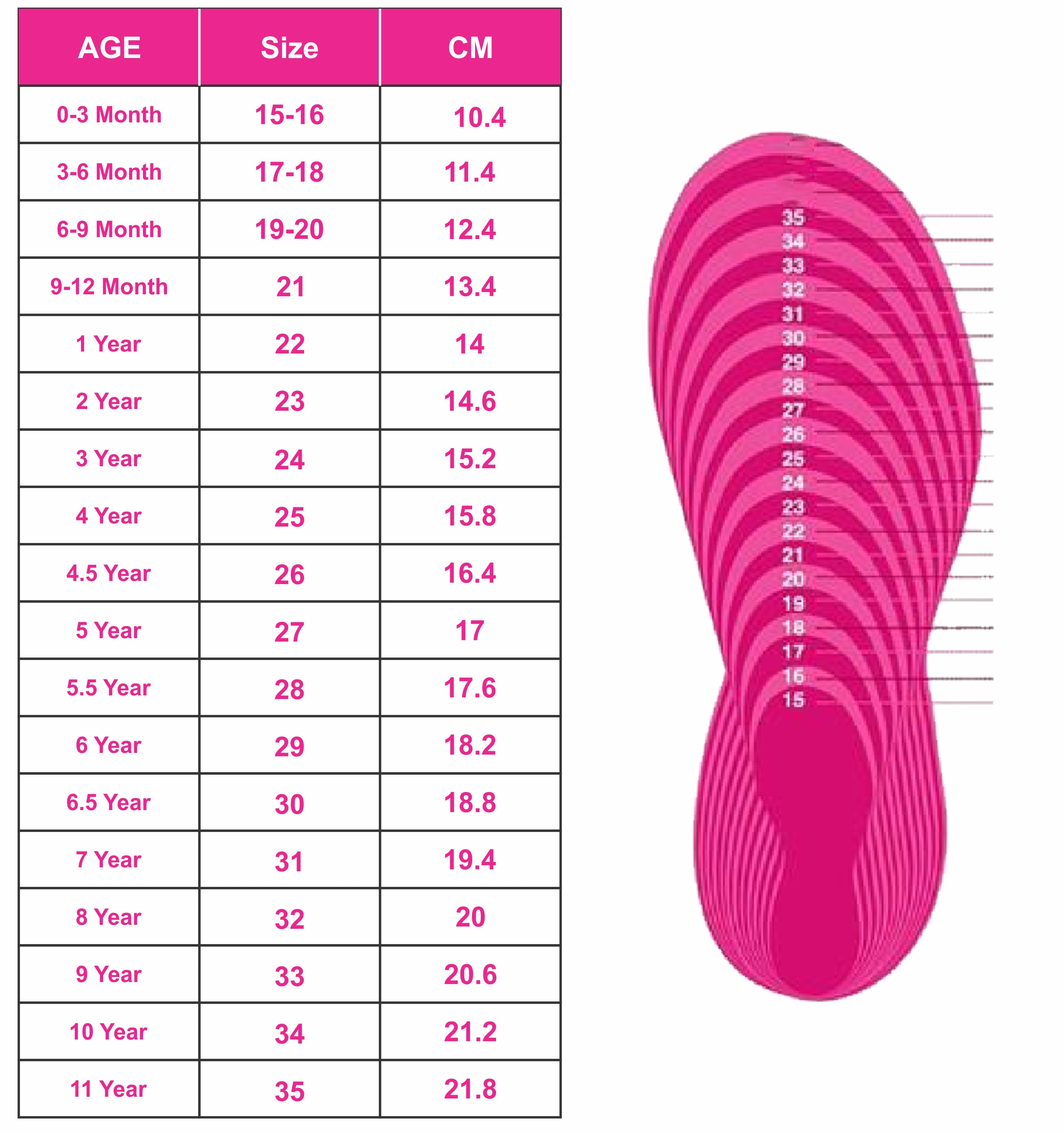
Measuring your feet at home gives you a useful reference when a size chart is unclear. You need a sheet of paper, a pen, a ruler or tape measure, and the socks you expect to wear with the shoes. Measure both feet because one may be longer or wider than the other.
Measure later in the day if that fits your usual shopping routine, since feet can swell during normal daily activity. Stand up while measuring so your feet bear weight. Keep the paper on a firm, flat surface rather than on a thick rug.
Source: i.etsystatic.com
Gather your supplies
Use paper, a pen, a ruler or measuring tape, and your usual shoe socks.
Trace the foot
Place one foot on the paper while standing. Hold the pen upright and mark the back of the heel and the tip of the longest toe.
Measure the length
Measure the straight distance between the heel mark and the longest-toe mark. Record the result in inches or centimeters.
Measure both feet
Repeat the process on the other foot and keep the larger measurement for size selection.
Check the width
Measure the widest part of the foot if the brand provides width guidance. Length alone may not explain a tight fit.
How to Use Your Measurements
Compare your measurements with the size chart for the exact brand and model. If the chart gives a foot-length range, select the size that covers your measurement and follow any instructions about fit or extra room.
Do not assume that a foot measuring a certain number of inches always maps to the same size across every brand. The chart may use foot length, shoe length, or another sizing convention. Read the labels before comparing the numbers.
If your feet fall between two sizes, check the fit notes and width options. A longer size may solve a length problem but can create heel slip. A wider model may help if the length is right but the sides feel tight.
For a long foot
Use the brand’s length chart and make sure the longest toe has room without pressing against the front.
For a wide foot
Look for a wide option or a roomier shape rather than automatically buying a much longer shoe.
For different foot lengths
Fit the longer foot first and check whether the other foot remains secure.
How to Check Whether the Converted Size Fits
A converted size is only useful when the shoe fits your foot. Try both shoes while standing, lace them as you normally would, and walk around on a safe, level surface. Pay attention to pressure, slipping, and whether your toes can move freely.
The front of the shoe should not press against your longest toe. Your heel should feel secure without rubbing, and the sides should not squeeze your foot. There is no single toe-room measurement that works for every shoe shape, so follow the brand’s fit guidance and assess comfort while moving.
Source: images.template.net
Check toe room
Make sure your longest toe does not press into the front when you stand or walk.
Check the heel
A small amount of movement can occur in some shoe designs, but repeated slipping or rubbing suggests a poor fit.
Check the sides
The upper should not pinch the toes or press painfully against the widest part of your foot.
Walk in the shoes
Notice any sharp pressure, rubbing, toe impact, or feeling that your foot slides forward.
Signs That You Need Another Size or Shape
If your toes touch the front, the shoe may be too short or too shallow. If the heel slips with each step, the shoe may be too long, too wide, or poorly matched to your heel shape. If the sides feel tight even when the length is right, try a different width or model.
Do not count on a tight shoe stretching enough to fix a poor fit. Some materials soften with use, but the amount varies, and extra room in one area will not always solve pressure in another. Return or exchange the pair if the fit remains uncomfortable within the seller’s return terms.
Pain or numbness
Stop wearing the shoe if it causes pain, numbness, or persistent pressure. Try a better-fitting option.
Repeated blisters
Check for rubbing at the heel, toes, and sides. The problem may involve shoe shape as well as size.
Foot sliding
Check the lacing and heel fit. If the foot still moves too much, try another size or model.
Why Shoe Brands May Use Different Conversions
Shoe sizing is not perfectly uniform across all brands. A US size is a label within a sizing system, but the shape and internal dimensions of the shoe can vary. This is why a conversion chart from one retailer may not match another chart exactly.
Brands may also use different size increments or offer different ranges of half sizes. Some product pages show men’s, women’s, and youth sizes side by side, while others list only the selected category. A model that shares a design across adult and youth sizes may still have differences in fit or construction.
The safest approach is to treat general conversion charts as a first step and the manufacturer’s chart as the next step. If the manufacturer gives no clear comparison, use a retailer with a suitable return policy and check the fit before removing tags or wearing the shoes outdoors.
Source: stepwithshoes.com
Brand sizing
A size 8 in one brand may not feel the same as a size 8 in another.
Shoe shape
A narrow toe box, deep heel cup, or low upper can change how the shoe feels.
Different product lines
Running shoes, dress shoes, boots, and sandals may fit differently even within one brand.
Size availability
Some youth ranges lack the half size or width you need, even when the length conversion appears correct.
What to Do When Two Charts Disagree
First, confirm that both charts use US sizes and that both refer to the same category. A women’s chart should not be compared directly with a toddler chart. Next, look for the official size guide for the exact model.
If the model-specific chart differs from a general conversion chart, use the model-specific guidance as your starting point. If the shoe still feels wrong, fit and comfort take priority over a formula. Consider contacting the brand or seller when the size labels remain unclear.
Confirm the sizing system
Check whether the numbers are US, UK, or European sizes.
Check the product category
Make sure the chart refers to women’s and big kids’ sizes, not toddler or little kids’ sizes.
Use the exact model chart
Choose the chart published for the shoe you plan to buy rather than relying on an unrelated model.
Common Mistakes When Comparing Women’s and Kids’ Shoes
Most shoe-size mistakes happen when shoppers treat a conversion as an exact match. The formula can save time, but it cannot account for every foot shape, material, or model. A few simple checks can prevent an avoidable exchange.
Source: cdn.shopify.com
Using the same number across categories
A women’s size 6 is not automatically the same as a big kids’ size 6. Use a conversion chart and check the correct category.
Confusing youth and toddler sizes
Toddler, little kids’, and big kids’ sizing cover different ranges. Confirm the label before you order.
Ignoring width
A shoe can be long enough but still pinch the sides. Check width options and the shape of the toe box.
Assuming all brands fit alike
A size that works in one brand may not work in another. Review the exact product chart.
Choosing only by price
A lower price does not help if the shoe causes pain or cannot be returned. Check the fit, intended use, and return terms.
Ignoring activity needs
A casual shoe and a running shoe have different demands. Make sure the model suits the way you plan to use it.
A Simple Checklist Before Buying
Before placing an order, confirm the US sizing category, estimate the equivalent size, and compare your foot measurements with the manufacturer’s chart. Review width options and check whether the product page explains any special fit notes.
If possible, try the shoes indoors and keep the packaging until you know the fit is right. For online orders, read the return policy before buying. These steps are especially useful when the youth size range offers fewer half sizes or width choices.
Before ordering
Confirm the category, conversion, brand chart, width, intended use, and return terms.
After delivery
Try both shoes, stand up, walk on a safe surface, and check for pressure or slipping.
If the fit is poor
Exchange the pair or try a different width or model rather than forcing an uncomfortable fit.
Frequently Asked Questions
Q
What is the difference between women’s and big kids’ shoe sizes?
Women’s and big kids’ US shoe sizes often differ by about 1.5 size numbers for a similar length. For example, women’s size 8 may be close to big kids’ size 6.5. The exact match depends on the brand and model, and the two shoes may differ in width, shape, or construction.
Q
What is a women’s size 7 in children’s shoes?
A women’s US size 7 is often estimated to be close to a big kids’ US size 5.5. Check the manufacturer’s size chart before buying, since some brands use different conversion rules and may not offer every half size.
Q
What is a women’s size 8 in big kids’ shoes?
A women’s US size 8 may correspond to a big kids’ US size 6.5 under the common conversion estimate. Use this as a starting point, then compare foot length, width, and model-specific fit details.
Q
Can adults wear big kids’ shoes?
Yes, adults can wear big kids’ shoes when the size, width, shape, and support meet their needs. The label alone does not determine whether the shoe is suitable. For running or long periods of standing, check the model’s intended use and make sure it feels secure and comfortable.
Q
Are kids’ shoes narrower than women’s shoes?
Some kids’ shoes may feel narrower or have a different shape from adult shoes, but this is not true of every brand or model. Compare the width options and fit notes for the exact shoe. If the sides pinch while the length feels right, try a wider option or a different design.
Q
Should I size up when buying kids’ shoes instead of women’s shoes?
Do not size up automatically. Start with the brand’s conversion chart and your foot measurements, then assess the actual fit. A larger size may create heel slip or extra movement if the shoe is already long enough. Choose a different width or shape if the main problem is side pressure.
Q
Can I use a women’s shoe size chart for all children’s shoes?
No. Women’s conversion charts generally apply to big kids’ or youth sizes, not toddler or little kids’ sizes. Confirm the size category and the US sizing system before using a conversion. For younger children’s shoes, use the brand’s own chart for that age and size range.
✦ Wrapping Up
Conclusion
Comparing women’s and children’s shoe sizes is easier when you start with the common US conversion estimate. Subtracting about 1.5 sizes from a women’s size can help you find a likely big kids’ equivalent. A women’s size 8, for example, may be close to a big kids’ size 6.5.
Still, the number is only a guide. Shoe brands use different sizing details, and youth shoes may have a different shape, width, or level of support. Measuring both feet and checking the exact brand chart can help you make a better choice, especially when buying online.
💡 Key Takeaway
Write down the length of your larger foot, find the official size chart for the shoe you want, and use the women’s-to-big-kids conversion only as a starting point. Check toe room, width, and heel fit before keeping the pair.