Puma women’s shoes generally follow standard US women’s sizing, but the best size depends on your foot length, width, and shoe model. Measure both feet, compare your longer foot with the official Puma size chart, and check the fit notes for the exact pair before buying.
Shopping for Puma shoes in the United States can feel simple until you face a wall of sizes. One pair may feel snug across the toes, while another in the same size may feel more relaxed. That difference can come from the shoe shape, upper material, and intended use, not just the number on the box.
This guide explains Puma women’s shoes sizing in plain English. You will learn how to measure your feet at home, read US, UK, and EU size charts, and decide whether to stay with your usual size or consider another option. The advice applies to casual sneakers, running shoes, and many other women’s footwear styles, though the exact model always matters.
Puma women’s footwear is sold in several sizing systems, including US, UK, and European sizes. These systems use different numbers for similar foot lengths. A US women’s size 8, for example, is not the same numbered size as a UK 8 or EU 8.
The safest way to choose a pair is to measure your foot in centimeters and compare the result with the chart supplied by Puma for your region and product category. Use the measurement guidance provided by the brand rather than relying only on a size you wear in another shoe brand.
A size chart is a starting point, not a promise that every shoe will feel identical. A low-profile lifestyle sneaker, a cushioned running shoe, and a structured training shoe can fit differently because they serve different needs.
Source: runrepeat.com
US women’s size
This is the size label commonly used by American footwear retailers. Make sure the chart specifically says women’s sizing rather than men’s or unisex sizing.
UK size
The UK scale uses different numbers from the US women‘s scale. Check the conversion on the product page or the official size chart.
EU size
European sizes use another numerical scale. Treat the EU value as a separate label, not as a direct match to the US number.
Foot length in centimeters
This measurement gives you a useful reference across sizing systems. Follow the chart’s instructions to determine whether its centimeter value represents foot length or another measurement.
Why the Same Size Can Feel Different
Shoe size describes a length range, but it does not fully describe the shape of the shoe. Toe-box width, instep height, heel shape, and upper stiffness can all change how a pair feels. Two Puma models with the same size label may therefore feel different on the same foot.
Materials also play a role. A soft upper may relax slightly with wear, while a firm synthetic upper may hold its shape. Do not count on a tight shoe stretching enough to fix toe pressure, numbness, or a painful pinch.
Length
Check the space in front of your longest toe while standing.
Width
Look for pressure at the sides of the forefoot and around the little toe.
Heel hold
Your heel should feel secure without painful rubbing or excessive slipping.
Puma Women’s Shoe Size Chart and Conversions
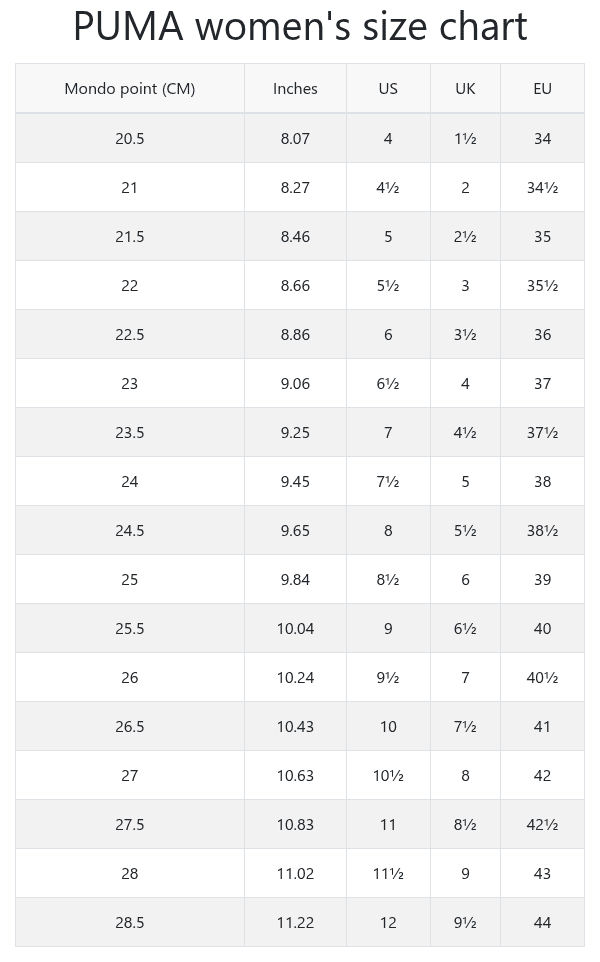
A conversion chart helps you compare size labels, but the official Puma chart for your exact market should be your final reference. Conversion values can vary by chart, rounding method, and product category. Avoid treating a generic chart as a guarantee of the fit of a particular model.
The table below gives a practical way to approach conversion without guessing at exact international equivalents. Enter the size printed on your current shoe, identify the sizing system, and check the corresponding Puma product chart before ordering.
Source: ar.inspiredpencil.com
If you shop in the United States
Choose the US women’s column on Puma’s official chart. Do not select a men’s or unisex size just because the number looks familiar.
If you shop using UK sizing
Use the UK column or the retailer’s stated conversion. Do not subtract or add a fixed amount unless the relevant chart supports it.
If you shop using EU sizing
Match your measured foot length with Puma’s EU chart, then confirm the US equivalent if the retailer displays both.
A Practical Size Conversion Checklist
Rather than using a universal conversion rule, work through the chart in the same order each time. This reduces errors when you switch between American retailers and international sellers.
If a retailer lists only one sizing system, confirm which system it uses. A product labeled size 7 may refer to different sizes depending on whether the listing uses US women’s, US men’s, or UK sizing.
Step 1
Measure both feet in centimeters while standing.
Step 2
Find the longer measurement and locate it on the relevant Puma size chart.
Step 3
Read the US, UK, or EU label that matches the retailer’s sizing system.
Step 4
Check the exact shoe’s fit notes, especially if it is a running, training, or narrow-profile model.
Why This Guide Avoids One Fixed Conversion Table
International size conversions are not perfectly uniform across every brand and chart. A number copied from an unrelated retailer can create false confidence, especially when the chart does not identify whether its measurements represent foot length or shoe length.
For a dependable result, use Puma’s current chart for the product and region you intend to buy from. The chart image in this guide can help you understand the layout, but confirm any numerical conversion against the brand’s official information.
Check the chart heading
Confirm that it covers women’s footwear rather than apparel or children’s shoes.
Check the units
Make sure you are reading centimeters, inches, or the correct size scale.
Check the model
Use any model-specific sizing notes shown by Puma or the retailer.
How to Measure Your Feet at Home
Measuring your feet at home takes only a few minutes and gives you a better starting point than guessing from your usual shoe size. You need a sheet of paper larger than your foot, a pencil, a ruler, and the socks you expect to wear with the shoes.
Measure late in the day if possible. Feet can expand during normal daily activity, so a measurement taken after you have been up and walking may better reflect the room you need. Stand naturally and put your weight evenly on both feet.
Source: rmkshoes.com
Get your tools ready
Place a sheet of paper on a hard, level floor against a wall. Keep a ruler nearby and wear your usual shoe socks.
Trace your foot
Stand on the paper with your heel lightly touching the wall. Keep the pencil upright and mark the end of your longest toe.
Measure the length
Measure from the wall-side heel position to the toe mark in centimeters. Repeat the process for the other foot.
Use the longer measurement
Compare the longer foot measurement with Puma’s chart. If the measurement falls between listed values, review the chart’s guidance and the model’s fit notes.
Measure Foot Width Too
Length is only part of the fit. If your shoes often pinch at the sides, measure the widest part of your forefoot as well. This can help you recognize a width problem that a longer shoe might not solve.
Puma models may differ in their available width options and internal shape. If your foot is broad, look for a model with a roomier forefoot and check whether the manufacturer lists a wide version. Do not assume that every Puma women’s shoe comes in several widths.
Pressure on the little toe
This may indicate that the toe box is too narrow or tapered for your foot.
Foot sliding from side to side
The shoe may be too wide, too long, or poorly matched to your foot shape.
Pain across the top
A low instep opening or tight lacing may be contributing to the pressure.
Avoid Common Measurement Errors
A tracing made while sitting can underestimate the room your foot needs when standing. Pressing the pencil at an angle can also distort the outline. Repeat the measurement if the result seems far from the size you usually wear.
Use the same method on both feet and record the measurements. If you get very different results on repeated attempts, check the position of the paper, the wall, and the ruler before choosing a size.
Do not measure only one foot
Many people have a small difference in foot length, and the longer foot usually sets the minimum length needed.
Do not add extra length blindly
The manufacturer’s chart and the shoe’s intended use should guide your choice.
Do not use an old shoe as your only guide
An old pair may have stretched, compressed, or been labeled in a different sizing system.
Should You Size Up or Down in Puma Women’s Shoes?
Do not automatically size up or down in Puma women’s shoes. Start with the size that matches your measured foot length on the relevant chart, then adjust your choice only when the specific model’s fit information or a proper try-on supports it.
A shoe that feels tight can be too short, too narrow, or too shallow over the instep. Each problem needs a different fix. Going up a full size may create excess length if the real issue is the shape of the toe box.
Source: wayupsports.com
Consider a larger size when
Your toes touch the front, your foot feels cramped in length, or the chart places your measurement at the upper edge of a size range and the model’s guidance supports moving up.
Consider a different model when
The length feels right but the sides pinch, your instep feels compressed, or your toes cannot spread naturally.
Consider a smaller size when
Your heel slips repeatedly and there is clear excess length, provided a secure lacing adjustment does not solve the problem.
What If You Are Between Sizes?
If your measurement falls between two sizes, check the exact model’s fit notes before deciding. The upper material, toe shape, and intended activity can all affect which option feels better. The official chart should remain your starting point.
If both sizes are available and returns are easy, trying both indoors can help. Wear the socks you plan to use, lace each shoe as you normally would, and walk around on a clean floor. Keep the pair that holds your heel securely while giving your toes enough room.
For casual wear
Aim for a secure fit with no sharp pressure, toe contact, or repeated heel slip.
For running
Allow comfortable toe movement and extra room for normal foot expansion during activity, without letting the foot slide inside the shoe.
For training
Look for secure side-to-side support and a fit that does not allow your foot to move around during changes of direction.
How Much Space Should Be at the Toe?
Your longest toe should not press against the front of the shoe when you stand. A small amount of free space helps prevent contact during walking, but the exact amount that feels right depends on the activity, the shape of your toes, and the shoe design.
Do not rely on a fixed finger-width rule alone. Pressing the outside of the toe box may not reveal the actual space above or around your toes. Remove the insole if the design allows it and assess your foot position, or ask a footwear specialist to help with fit.
A good sign
Your toes can move without hitting the front or being squeezed together.
A warning sign
You feel toe pressure, tingling, or pain after a short walk.
Too much room
Your foot slides forward or your heel lifts with each step.
Puma Women’s Running Shoes vs. Casual Sneakers
Running shoes and casual sneakers can need different fits, even when both carry the Puma name. Running involves repeated forward movement and impact, while casual shoes may prioritize everyday comfort or a particular style. Choose a fit that suits the activity rather than assuming your favorite sneaker size will work in every model.
A running shoe should hold your heel and midfoot while leaving enough room for your toes. A lifestyle sneaker should also feel comfortable when standing and walking, but its shape may be narrower, firmer, or less flexible. The model’s construction matters as much as the number on the label.
Source: shoechartprintables.com
Running shoes
Check toe clearance, heel security, and comfort during a brief walk or jog if the retailer permits it.
Lifestyle sneakers
Check for pressure across the forefoot and whether the shoe stays secure during ordinary walking.
Training shoes
Check the fit during controlled side steps and turns. The foot should not slide inside the shoe.
Choosing a Fit for Long Walks
For long walks, comfort should remain steady rather than fading after a few minutes. Try the shoes with the socks you normally wear and walk long enough indoors to notice pressure at the heel, arch, and forefoot.
If your feet tend to swell during long periods on your feet, leave enough space for normal expansion. Do not solve swelling by buying a shoe so long that your heel slips. A different width or shape may be the better answer.
Check the forefoot
Your toes should not feel trapped when you push off.
Check the heel
A small amount of movement may occur in some designs, but repeated rubbing or strong lift is a sign to reassess the fit.
Check the upper
The material should not create painful pressure across the top of your foot.
Choosing a Fit for Running
For running, try the shoes later in the day or after normal activity when your feet may be slightly larger. Wear your usual running socks and assess the fit while standing, walking, and jogging in a safe setting if permitted.
A shoe that feels snug while sitting may become uncomfortable during a run. On the other hand, excess space can let the foot slide, which may cause friction. Use both toe room and secure heel hold to judge the fit.
Test both feet
The smaller foot should not slide, and the longer foot should not hit the front.
Check lacing
Adjust the laces evenly before deciding the shoe is the wrong size.
Stop if pain develops
Do not use a long run to break in shoes that cause sharp pain, numbness, or repeated blisters.
How to Get a Better Fit for Wide or Narrow Feet
Foot width can matter just as much as foot length. If your Puma shoes feel tight across the ball of the foot but have enough room in front of your toes, the problem may be width or shape rather than size.
A longer shoe is not always the right answer for a wide foot. It can make the heel slide and change how your foot sits over the sole. Look for a model whose forefoot shape better matches your foot, and check whether the product offers a documented wide-fit option.
Source: twilza.com
For wide feet
Look for a roomier toe box and avoid models that squeeze the sides of your forefoot.
For narrow feet
Check heel hold and midfoot security. Lacing may help if the shoe otherwise fits well.
For a high instep
Look for an upper and lacing system that do not press painfully on the top of your foot.
For different-sized feet
Fit the longer foot first and assess whether the shorter foot can be secured without uncomfortable tightness.
Can Puma Shoes Stretch With Wear?
Some upper materials may soften or relax slightly with use, but the amount varies by model and material. The sole length and basic shape will not change enough to fix a shoe that is clearly too short.
Do not assume that a painful fit will become comfortable after a few weeks. If the shoe pinches, causes numbness, or forces your toes together, try a different size or model instead of relying on stretching.
Mild stiffness
A short indoor try-on may help you decide whether the material feels naturally firm or creates a problem.
Strong pressure
Choose a better-fitting shoe rather than expecting the upper to expand substantially.
Persistent pain
Stop wearing the pair and seek advice if pain continues or affects normal walking.
How to Check the Fit When Buying Puma Shoes Online
Online shopping makes it easy to compare colors and styles, but you cannot feel the shoe before it arrives. Reduce the risk by checking the size chart, the exact model name, the retailer’s sizing system, and the return terms before you place your order.
Product photos alone cannot tell you whether the shoe will suit your foot width or instep. Read model-specific fit notes when available, and treat customer comments as individual reports rather than proof that the shoe runs small or large for everyone.
Source: sportsa.co.za
Confirm the model
Make sure the listing describes the exact Puma shoe you intend to buy, not a similar-looking style.
Confirm the sizing system
Check that the selected number is US women’s sizing if that is what you need.
Review returns
Check deadlines, return shipping costs, and whether indoor try-ons are allowed.
Keep the packaging
Save the box and tags until you are satisfied with the fit and know the return conditions.
How to Try on a New Pair at Home
Try the shoes indoors on a clean surface. Wear your normal socks, tie the laces as you would for daily use, and stand with your weight evenly distributed. Check both feet before walking around.
Walk, turn, and gently shift your weight. Your toes should not strike the front, the sides should not pinch, and your heel should feel secure. If the fit feels wrong within a few minutes, do not assume that outdoor wear will solve the problem.
Pass
The shoe feels secure, your toes can move, and no area creates sharp or growing pressure.
Recheck
The shoe feels slightly loose or tight in one area, and you have not yet checked the lacing or size chart.
Return or exchange
The shoe is too short, pinches, causes numbness, or slips enough to affect your walking.
How to Read Customer Fit Reviews
Look for reviews from people who describe similar foot traits and use. A runner with broad feet may have a different experience from someone buying the same shoe for occasional wear. Comments about heel slip, toe pressure, and width are more useful than a simple statement that the shoe fits perfectly.
Check whether reviews refer to the same model and version. A general review of Puma footwear may not tell you much about the fit of a specific running shoe or fashion sneaker.
Useful review detail
The reviewer states their usual size, foot width, and whether the selected size felt short, long, or narrow.
Less useful review detail
The reviewer gives a size opinion without saying which model they bought or how the shoe fit.
Common Puma Women’s Sizing Mistakes to Avoid
Most sizing mistakes happen when shoppers focus on one number and ignore how the shoe fits. Your usual size, an international conversion, or a reviewer’s experience can all help, but none should replace a proper measurement and model-specific check.
Use these common mistakes as a final review before buying. A few extra minutes can help prevent the cost and hassle of returning an uncomfortable pair.
Source: golfbox.com.au
Assuming every brand fits alike
A US women’s size from another brand may not feel the same in every Puma model. Compare foot length and fit details.
Mixing men’s and women’s sizes
Confirm the label before ordering, especially when a listing includes men’s, women’s, and unisex options.
Choosing a size based on appearance
A sleek or narrow-looking shoe may have a different internal shape from what its photos suggest.
Ignoring width
Going longer may not solve pressure at the sides of the foot. Try a roomier shape when length already feels right.
Buying a painful fit to break it in
New shoes should not cause sharp pain, numbness, or strong pressure. Exchange them if the fit is wrong.
Skipping the return policy
Check the retailer’s terms before purchase so you know whether an indoor try-on qualifies for an exchange.
What If Your Usual Size Does Not Fit?
First, check that you selected the correct sizing system. Next, compare your current foot measurement with Puma’s chart. Then decide whether the problem comes from length, width, heel hold, or pressure over the instep.
If the length is correct but the shoe remains uncomfortable, another model may suit your foot better. If the shoe is clearly too short or long, compare the adjacent size while checking how that change affects heel security.
Too short
Check the next suitable size and confirm that it does not become too loose at the heel.
Too narrow
Look for a wider or differently shaped model rather than simply adding length.
Too loose
Recheck the length and try suitable lacing adjustments if the shoe is otherwise the right shape.
A Simple Final Fit Checklist
Before keeping a new pair of Puma women’s shoes, check length, width, heel hold, and comfort together. A correct size label is useful, but the way the shoe fits your foot is what matters when you walk or run.
Use the checklist below during an indoor try-on. If a shoe fails one of the key comfort checks, correct the issue with a reasonable adjustment or consider an exchange before wearing it outside.
Source: navyselectedshop.com
Length
Your longest toe does not hit the front when you stand or walk.
Width
The sides of your forefoot feel comfortable without squeezing or spilling over the sole.
Heel
Your heel feels secure, with no strong slipping or painful rubbing.
Instep
The upper and laces do not create painful pressure across the top of your foot.
Movement
You can walk and turn without your foot sliding around inside the shoe.
Activity
The fit suits the intended use, whether that is daily wear, training, walking, or running.
When to Ask for Help With Fit
If you cannot find a comfortable fit after checking the size chart and trying suitable sizes, ask a footwear specialist for help. They can assess foot length, width, and shoe shape together. Persistent foot pain, numbness, or swelling may also need advice from a qualified health professional rather than another size change alone.
People who use prescribed orthotics should check whether the shoe can accommodate them without lifting the heel or crowding the toes. Do not remove built-in shoe parts unless the manufacturer allows it and doing so does not affect the intended fit or support.
Seek fitting advice
Ask for help if your feet differ greatly in size or standard shoes repeatedly cause pressure.
Stop wearing a painful pair
Do not continue use if the shoe causes numbness, sharp pain, or changes the way you walk.
Frequently Asked Questions
Q
Do Puma women’s shoes run true to size?
Puma women’s shoes often start with standard women’s sizing, but fit can vary by model and foot shape. Measure your feet and compare the result with Puma’s official chart. Then check the exact product’s fit notes before choosing your size.
Q
Should I size up in Puma women’s sneakers?
Not automatically. Consider sizing up only when your measurements, the model’s guidance, or a proper try-on shows that the current size is too short or too snug in length. If the sides pinch while the length feels right, a different shoe shape may be a better option.
Q
How do I convert Puma women’s US sizes to UK sizes?
Use Puma’s current conversion chart for the product and market you are shopping in. US women’s and UK sizes use different scales, so do not assume the numbers match. Measuring your foot in centimeters gives you a useful way to verify the listed conversion.
Q
Are Puma women’s shoes suitable for wide feet?
Some Puma models may feel roomier than others, but width depends on the shoe’s design and the options offered for that model. Look for a documented wide-fit version if available, and check for side pressure during an indoor try-on. A longer size alone may not solve a width problem.
Q
How much room should I leave in Puma running shoes?
Your longest toe should not touch the front when you stand or move. Leave enough space for comfortable toe movement and normal foot expansion during activity, while keeping the heel secure. The right amount varies with foot shape and shoe design, so assess the fit rather than relying on one fixed rule.
Q
Can I use my regular sneaker size for Puma shoes?
Your regular sneaker size is a useful starting point, but it is not a guarantee. Different brands and Puma models can vary in width, toe shape, and internal fit. Compare your measured foot length with Puma’s chart and try the shoes on before committing to them.
Q
What should I do if one foot is larger than the other?
Choose a size that gives your longer foot enough room without causing pain or toe contact. Then check whether the shorter foot remains secure. Suitable lacing may help with a small difference, but a footwear specialist can assist if the difference makes standard shoes hard to fit.
✦ Wrapping Up
Conclusion
Finding the right Puma women’s shoe size starts with a simple measurement, not a guess based on your last pair. Measure both feet, use the longer measurement, and compare it with the official chart for the model and region you plan to buy from.
Next, check the shape of the shoe and the needs of your activity. A comfortable casual sneaker, a running shoe, and a training shoe may fit differently even when the size label is the same. Give attention to toe room, forefoot width, heel hold, and pressure across the top of the foot.
When shopping online, confirm the sizing system and review the return policy before ordering. If the shoe pinches, causes numbness, or slips badly, do not assume that breaking it in will fix the problem. Try another size or model that better matches your foot.
💡 Key Takeaway
Measure both feet in centimeters today, check Puma’s official women’s footwear chart, and verify the exact model’s fit notes before selecting your size.