Women’s panties sizes usually range from XS to 4XL or higher, but the right size depends on your hip measurement, the brand’s size chart, and the cut of the underwear. Measure around the fullest part of your hips, then compare that number with the brand’s US size chart before you buy.
Shopping for women’s underwear in the United States can feel confusing. One store may label a pair Medium, while another uses a number such as 8 or 10. Some brands also use waist and hip measurements, which can make size labels even harder to compare.
The best way to choose a panty size is to start with your body measurements instead of guessing from your usual jeans size. The fit can also change with the fabric, rise, leg opening, and amount of stretch. A simple measuring step can help you avoid underwear that digs into your skin, slips down, or bunches under clothes.
This guide explains common US women‘s panties sizes, how to measure your hips, and how to read a size chart. You will also learn how to spot a poor fit, compare underwear styles, and shop online with more confidence. Keep in mind that size ranges are not the same across all brands, so a manufacturer’s chart should always take priority over a general guide.
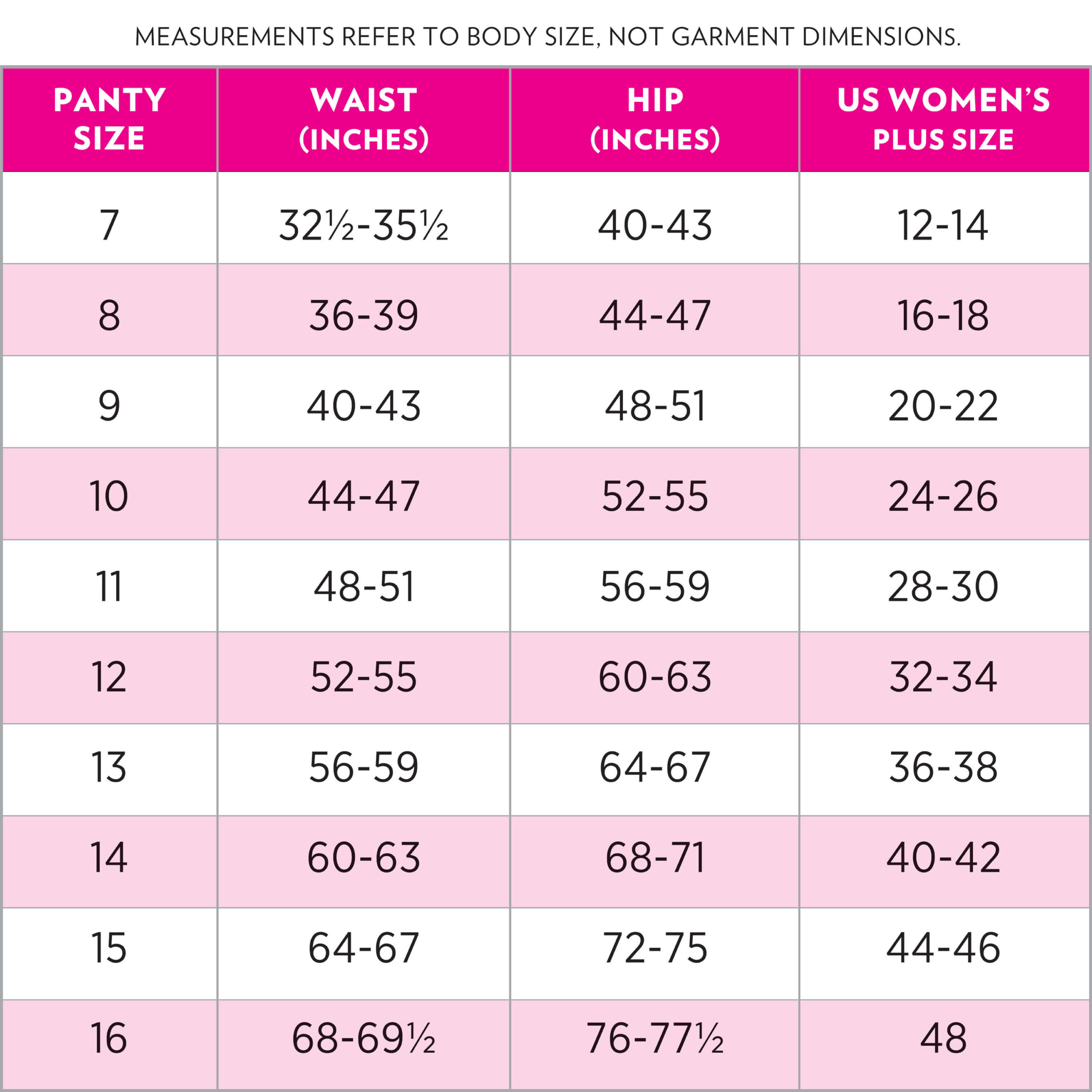
A general women’s panties size chart can help you narrow down your options, but it cannot replace a brand-specific chart. US underwear labels often use XS, S, M, L, XL, and extended sizes. Some brands also use numeric sizes or list hip measurements in inches.
The table below gives a broad example of how letter sizes may relate to hip measurements. These are illustrative ranges, not a universal industry standard. Always check the size guide for the exact product you plan to buy.
Source: sizechartwomen.com
Extra Small (XS)
Often intended for smaller hip measurements, but the exact range depends on the brand.
Small (S)
Usually sits below Medium on a brand’s size chart and may suit a smaller hip range.
Medium (M)
A middle size in many ranges, although the measurement limits differ by maker.
Large (L)
Designed for a larger measurement range than Medium within the same brand.
Extra Large (XL)
Provides more room than Large in many ranges, with the amount of extra room varying by brand.
2XL and above
Extended sizing may use 2XL, 3XL, 4XL, or plus-size labels. Check the listed measurements rather than assuming each brand uses the same scale.
Example Hip Measurement Guide
The following chart is a rough illustration of possible hip ranges in inches. It is not a verified size chart for any particular company, and the ranges should not be treated as exact size conversions.
XS
Example range: 32 to 34 inches.
S
Example range: 34 to 36 inches.
M
Example range: 36 to 38 inches.
L
Example range: 38 to 40 inches.
XL
Example range: 40 to 43 inches.
2XL
Example range: 43 to 46 inches.
3XL
Example range: 46 to 49 inches.
Why General Size Charts Can Be Misleading
Two brands can assign different letter sizes to the same hip measurement. One may have a relaxed cut with a soft waistband, while another may use a firmer elastic edge. The same label does not guarantee the same fit.
Some size charts list body measurements, while others may show garment measurements. These numbers are not interchangeable. If a chart does not explain its measurements, look for a fit guide or contact the seller before ordering.
Check the measurement type
Confirm whether the chart lists body measurements or the actual dimensions of the garment.
Read the size notes
Look for advice about stretch, snug fit, relaxed fit, and whether the product runs small or large.
Use the product chart
A chart made for the exact underwear line is more useful than a general chart found elsewhere.
How to Measure Your Panty Size at Home
You can measure for women’s panties sizes at home with a soft measuring tape and a mirror. The most useful measurement is usually the circumference around the fullest part of your hips and buttocks. Some brands also provide a waist measurement, so check the chart before you begin.
Measure over thin underwear or close-fitting clothing, rather than thick pants. Stand in a relaxed position with your feet close together. Keep the tape level and snug without pulling it tight enough to press into your skin.
Source: cozylace.com
What you need
A flexible measuring tape, a mirror, and a note or phone to record your measurement.
How to stand
Stand naturally with your weight balanced on both feet. Avoid sucking in your stomach or changing your posture to alter the number.
How to hold the tape
Keep the tape flat against your body. It should not twist, sag, or dig into your skin.
Step 1: Measure Around the Fullest Part of Your Hips
Wrap the tape around the widest part of your hips and buttocks. Check the mirror to make sure the tape stays level all the way around. Write down the measurement in inches because many US underwear charts use inches.
Repeat the measurement once to check your result. If the two numbers differ, adjust the tape and measure again. A small measuring error can matter when your body measurement falls close to a size boundary.
Example
If your hip measurement is 39 inches, look for a brand size chart that includes 39 inches in its recommended range.
Step 2: Measure Your Waist if the Brand Requests It
Find your natural waist, which is usually above the belly button and below the rib cage. Wrap the tape around this area without tightening it. Record the result only if the underwear brand uses waist measurements to guide its sizing.
Do not assume the narrowest part of your waist determines your panty size. Many briefs, bikinis, and hipsters sit lower on the body, so hip measurements often provide a better starting point.
For high-rise underwear
Check the waist guidance as well as the hip chart because the waistband may sit near your natural waist.
For low-rise underwear
Follow the brand’s instructions for hip or low-rise fit if they provide them.
Step 3: Compare Your Number With the Brand Chart
Find your measurement on the product’s size chart and select the size recommended for that range. If the chart lists both waist and hips, use the manufacturer’s directions for matching both numbers. If your measurements fall into different size bands, check the style’s fit notes or ask customer service for help.
Do not automatically choose a smaller size to get a smoother look. Tight underwear can create pressure lines, roll down, or cause friction. The goal is a secure fit that feels comfortable throughout normal movement.
If you fall between sizes
Review the brand’s advice, fabric stretch, and return rules. A larger size may be more comfortable if the smaller one would feel tight.
How Women’s Panties Sizes Compare With Clothing Sizes
Your jeans, dress, or leggings size can offer a rough clue about your underwear size, but it is not a dependable conversion. Clothing brands use different patterns and fit standards, and denim often includes stretch that changes how it feels on the body. Underwear has its own cut, elastic, and fabric needs.
A person who wears a size 8 in one pair of jeans may not wear the same numbered size in underwear. Some underwear brands use clothing sizes, while others use letter sizes and body measurements. Read the chart for the item rather than converting from pants by guesswork.
Source: i2.wp.com
Jeans size
Useful as a rough starting clue, but not a substitute for an underwear size chart.
Dress size
May not reflect hip shape, rise preference, or how underwear elastic fits.
Bra size
Does not determine panty size because it measures a different part of the body.
Previous underwear size
Useful if you are buying the same brand, style, and product line. Recheck sizing if the material or cut has changed.
Can You Convert a Numbered Size to S, M, or L?
There is no universal conversion from US clothing numbers to panty letter sizes. A brand may map a range of numbered sizes to Medium, while another may use a different chart. The only reliable conversion is the one supplied by the maker of the underwear.
If a product page lists a numeric size but does not show a chart, search the brand’s official sizing page. If that still does not answer the question, contact the seller before placing an order.
Avoid fixed conversion rules
Do not assume a specific dress size always equals Small, Medium, or Large in underwear.
Compare measurements first
Use your hip measurement to narrow the range, then confirm the label on the product chart.
Choose the Right Size for Different Panty Styles
The cut of the underwear can change how a size feels. Briefs, bikinis, hipsters, thongs, boyshorts, and high-rise styles cover different areas of the body. Even when two pairs share the same label, their leg openings, waistband height, and back coverage may differ.
Start with the size chart, then consider how the style is meant to sit. A size that feels secure in a full brief may feel different in a low-rise bikini or a thong. The garment should stay in place without pinching or requiring constant adjustment.
Source: m.media-amazon.com
Briefs
Often provide more front and back coverage. Check the waistband and leg openings for signs of tightness.
Bikini panties
Usually sit lower on the hips than classic briefs. The rise and side width affect the feel.
Hipsters
Often have wider sides and sit around the hips. Compare the hip measurement with the brand chart.
Thongs
Offer less rear coverage. The waistband and gusset should sit comfortably without pulling or rubbing.
Boyshorts
Have a longer leg line. Check the leg openings because they may fit differently from briefs.
High-rise panties
Sit higher on the torso. Review waist and hip guidance if both measurements are listed.
Does a Different Style Mean You Need a Different Size?
Not always. If you are buying a new style from a familiar brand, start with the chart for that product. A different cut may fit well in your usual size, but a change in fabric or waistband design can affect comfort.
Pay close attention to the product’s fit notes. If the maker says a style has a snug fit or limited stretch, that information may matter more than the label alone.
Check the rise
A low-rise pair may sit below the area measured for a high-rise style.
Check the leg openings
A tight leg edge can cause discomfort even when the hips fit well.
Check the gusset
The crotch panel should sit in place without pulling, shifting, or bunching.
How Fabric Affects the Fit of Women’s Underwear
Fabric changes how panties stretch, recover, and sit against the skin. Cotton, cotton blends, microfiber, nylon, and lace may all feel different, even when the size label is the same. Look at the fabric content and the product’s fit notes before you choose.
Stretch can make underwear easier to pull on, but it does not mean you should size down. A fabric that stretches well should still return to shape and stay in place during normal movement. If a pair feels tight or leaves deep marks, check both the size and the cut.
Source: cdn.hanes.com
Cotton
Often feels soft and breathable. Cotton with little or no elastane may stretch less than a blended fabric.
Cotton blends
May include elastane or spandex for stretch and shape retention. The blend and construction affect the feel.
Microfiber and synthetic blends
Can feel smooth and light. Check the product details to understand the material and amount of stretch.
Lace
May have stretch panels or firmer edges. Pay attention to seams and elastic where they touch the skin.
Should You Size Down for Stretchy Panties?
Usually, you should follow the manufacturer’s chart rather than sizing down simply because a fabric stretches. Stretch is designed to help the garment move with your body, not to make a smaller size fit every person.
If you are between sizes, check whether the brand recommends the smaller or larger option. If the chart gives no guidance, consider the amount of coverage you prefer and the risk of tight elastic. A comfortable fit matters more than a smaller label.
Look at the fiber blend
The listed materials can help explain why two pairs feel different.
Check care directions
Follow the label when washing and drying. Excess heat may damage elastic in some garments.
Signs Your Panties Are Too Small or Too Large
The right underwear size should feel secure without causing pain, pressure, or constant movement. You should be able to sit, walk, bend, and go about your day without needing to pull the garment into place. A poor fit can come from the size, the cut, or worn-out elastic.
Check how the underwear feels during ordinary movement, not just while standing in front of a mirror. A pair may look fine at first but roll down or dig in when you sit. Fit is about both measurements and how the garment behaves on your body.
Source: cdn.shopify.com
Signs the size may be too small
The waistband or leg openings dig in, the fabric pulls tightly across the hips, the seams press into the skin, or the gusset shifts out of place.
Signs the size may be too large
The waistband slips down, the fabric bunches, the leg openings gape, or the garment moves around when you walk.
Signs the elastic may be worn out
The underwear no longer stays in place even though the size used to fit, or the waistband has lost its ability to spring back.
How to Fix Common Fit Problems
If the waistband digs in, compare your measurements with the next size up and inspect the rise. A low-rise design may press in a different place than a high-rise pair. If the hips fit but the waistband feels tight, another cut may work better.
If underwear slips or bunches, check whether the size is too large or the fabric has lost its shape. A different style may also solve the issue. Do not assume every fit problem can be fixed by changing the size alone.
Rolling waistband
Check the size, rise, and elastic tension. A different waistband design may stay in place better.
Tight leg openings
Compare the size chart and try a cut with more room around the legs.
Bunching fabric
Check for excess fabric, a poor cut, or worn elastic before choosing a smaller size.
Skin irritation
Stop wearing a pair that causes rubbing or pain. Try a more comfortable fit and a fabric that suits your skin. Seek medical advice if irritation persists or becomes severe.
How to Buy Women’s Panties Online
Online shopping works best when you check the measurements and return rules before ordering. Product photos cannot show exactly how the waistband or leg openings will fit your body. Reviews may help you spot repeated fit comments, but individual experiences do not guarantee the same result for you.
Begin with the product page, not a generic underwear chart from a different site. Check the exact style, fabric blend, available sizes, and whether the seller lists body measurements. If you are unsure, contact the seller with your hip measurement and ask which size chart applies.
Source: ae01.alicdn.com
Read the size chart
Use the chart attached to the product or the brand’s official sizing page.
Read fit-related reviews
Look for comments about waistband tension, leg openings, stretch, and whether the garment shifts during wear.
Check the return policy
Underwear may have special return restrictions for hygiene reasons. Review the seller’s policy before buying.
Check the fabric details
Review the listed fibers, stretch content, lining, and care instructions.
Keep a note of the size that works
Record the brand, style, size, and fit. This can make future orders easier when you buy the same item again.
What If You Are Between Two Sizes?
Start by checking the brand’s instructions for people between sizes. If the maker recommends sizing up for comfort, follow that guidance. If the fabric has substantial stretch and the brand advises choosing the smaller size, consider that advice alongside your own comfort needs.
The better choice also depends on where you feel pressure. If the waistband or leg openings are already tight, a larger size or a different cut may help. If the garment slips and the fabric gathers, the smaller size may be worth considering only when the chart supports it.
For a snug fit
Choose a size within the brand’s recommended range that stays in place without pinching.
For a relaxed fit
Consider the larger option when it remains within the chart’s guidance and does not slip or bunch.
When the chart is unclear
Ask the brand for advice instead of relying on a fixed conversion from jeans or dress sizes.
Women’s Panties Sizes and Plus-Size Options
Many underwear brands offer extended sizes, including 2XL, 3XL, 4XL, and sizes above that range. Other brands use plus-size labels or numeric sizing. The available range and the measurements linked to each label differ by company, so the label alone cannot tell you how a pair will fit.
A useful plus-size chart should give clear body measurements and enough detail to help you choose. Look at the waistband height, hip coverage, leg openings, and fabric stretch. These features may matter as much as the size number when you want underwear that stays comfortable all day.
Source: d3d71ba2asa5oz.cloudfront.net
Check the upper end of the chart
Confirm that your measurement falls within the stated range instead of assuming a 3XL or 4XL has the same dimensions across brands.
Look for adequate coverage
Review the style and product details to see how much front, side, and back coverage it provides.
Consider waistband design
A wide or soft waistband may feel different from a narrow elastic band, even at the same size.
Check stretch and recovery
Look for fabric information and care instructions that help explain how the garment may retain its shape.
Does Plus-Size Underwear Use a Different Sizing System?
Some brands use the same letter-size system across their full range, while others have separate plus-size charts or extended numeric sizes. There is no single US standard that makes every brand’s 2XL or 3XL equal to the same hip measurement.
Use the exact chart for the product. If a brand lists only letter sizes without measurements, contact its support team before buying when fit is uncertain.
Use actual measurements
Choose by the manufacturer’s listed hip and waist ranges rather than the size label alone.
Review product construction
Check seams, leg openings, and waistband shape for features that affect comfort.
Frequently Asked Questions
Q
How do I know my women’s panties size?
Measure around the fullest part of your hips with a soft tape measure. Compare that number with the size chart for the exact brand and style. If the chart also asks for waist measurements, follow its instructions for matching both measurements.
Q
Is a size 8 the same as a Medium in women’s panties?
Not always. Some brands map a numbered size to Medium, while others use a different conversion. Check the manufacturer’s chart to see how its numbered sizes relate to letter sizes and hip measurements.
Q
Should I buy panties one size bigger?
You do not need to size up by default. Choose the size recommended for your measurements. Consider a larger size if your current pair digs into your waist or hips, but check whether the new size could cause slipping or bunching.
Q
Should panties fit tightly or loosely?
Panties should fit securely without digging into your skin or shifting around. The fabric should lie comfortably against your body, and the waistband and leg openings should not cause pain or ongoing pressure. The amount of snugness also depends on the style and fabric.
Q
Do women’s panties sizes vary by brand?
Yes. Brands can use different measurements, patterns, fabrics, and size ranges. A Medium in one brand may fit differently from a Medium in another, so use the chart for the specific product you want to buy.
Q
What measurement matters most when buying women’s panties?
The hip measurement is often the best starting point because it covers the fullest part of the hips and buttocks. Some styles and brands also use waist measurements, so follow the instructions on the product’s size chart.
Q
Can I use my jeans size to choose underwear?
Your jeans size can give you a rough starting point, but it is not a reliable conversion. Jeans and underwear use different patterns, fabrics, and fit standards. Measure your hips and compare the result with the underwear brand’s chart.
✦ Wrapping Up
Conclusion
Finding the right women’s panties sizes starts with one simple step: measure your hips and compare the result with the correct brand chart. Letter sizes and numeric labels can vary, so do not rely on a fixed conversion from jeans, dresses, or underwear from another maker.
Think about the style, fabric, waistband, and leg openings as well. A well-fitting pair should stay in place without digging in, slipping down, or bunching. If the size chart is unclear or your measurements fall between sizes, check the brand’s advice before placing an order.
💡 Key Takeaway
Measure the fullest part of your hips, record the result in inches, and use the exact product’s US size chart. Check the return policy before ordering and choose the size that offers a secure, comfortable fit.