There is no single official average pant size for women in the US. Research on American women’s clothing sizes has reported an average around sizes 16 to 18 in misses sizing, while another large community dataset reports an average dress size of 14. These figures refer to different data sources and clothing categories, so neither establishes one exact average pant size.
In the United States, women’s pants use numeric sizes such as 2, 6, 10, 14, and 18, as well as labels such as S, M, L, and XL. The problem is that these labels do not follow one universal sizing rule. A size 10 at one store may fit like a size 12 at another, even when both pairs are sold in the same country.
A 2017 study in the International Journal of Fashion Design, Technology and Education compared US women’s body measurements from national health survey data with clothing size standards. The researchers estimated that the average American woman would wear a misses size 16 to 18, corresponding to a women’s plus size around 20W under the standards they examined. A separate report from Mys Tyler, based on more than 42,000 American women in its community, reported an average dress size of 14. These findings help explain why a single number can be misleading.
For everyday shopping, your own waist, hip, and inseam measurements are more useful than the average. This guide explains what the available figures mean, how US pant sizes work, and how to choose a size that fits your body and the cut of the pants.
Source: i.etsystatic.com
What Is the Average Pant Size for Women in the US?
The average pant size for women in the US cannot be stated as one exact number with confidence. There is no single national dataset that directly establishes a current average retail pant size for all American adult women. Research on clothing sizes offers useful clues, but the type of size, the people studied, and the method used all matter.
A study published in 2017 found that national body measurement data from earlier survey years suggested an average American woman would fit a misses size 16 to 18 when compared with the clothing standards used by the researchers. The study also linked this range to women’s plus size 20W. The result challenged older ideas about the typical American clothing size, but it did not measure the actual pants sold or worn by every woman in the country.
Mys Tyler later published US sizing insights based on more than 42,000 adult women in its community, using data collected from 2020 through 2024. Its report listed size 14 as the average dress size and size 16 as the most common dress size. That is a large dataset, but it represents the platform’s community rather than a nationally sampled survey of all women. It also reports dress sizes, not a direct average of pants purchased or worn.
The safest answer is that the average depends on the source and the kind of clothing measured. For a shopper, these statistics are background information, not a target size or a reliable way to predict the fit of a particular pair of pants.
Source: cdn.shopify.com
Research-based estimate
A 2017 study estimated an average of misses size 16 to 18 from body measurement data and the sizing standards it compared.
Separate community finding
Mys Tyler reported an average dress size of 14 from its large US community dataset.
Practical shopping advice
Use your body measurements and the retailer’s own chart instead of relying on either average.
Why Do Different Sources Give Different Averages?
The figures can differ because the sources do not measure the same thing. One study compares measured body dimensions with established clothing standards. Another reports sizes within a particular community. A retail survey might instead ask shoppers what size they buy. These methods can produce different results.
Clothing sizes also change across brands and styles. A size 14 in one pair of jeans may not have the same waist or hip measurements as a size 14 in another brand. An average based on labels therefore does not describe one fixed set of body measurements.
Different samples
A national health survey and an online fashion community may include different groups of women.
Different measurements
Body measurements, dress labels, and pants purchased are separate measures and should not be treated as interchangeable.
How US Women’s Pant Sizes Work
Women’s pants in the United States commonly use numeric sizes, letter sizes, or waist measurements. Numeric sizes include 0, 2, 4, 6, 8, 10, 12, and higher numbers. Letter sizes include XS, S, M, L, and XL. Some brands use waist measurements in inches, while jeans may also list inseam length.
These systems are related, but they are not identical. A brand might place sizes 8 and 10 in its medium range, while another brand uses medium for sizes 6 and 8. Plus-size lines may use labels such as 16W, 18W, and 20W. These labels help organize a range, but they do not guarantee a fixed waist or hip measurement across stores.
The letter W often marks a women’s plus-size category. It does not simply mean that the pants have a longer leg or a wider waist. The pattern may use different proportions through the waist, hip, seat, and thigh. Regular numeric sizing and women’s sizing can therefore fit differently even when their labels look close.
Source: info.1688order.com
Numeric sizes
Numbers such as 6, 10, or 14 identify a brand’s size category, but the actual measurements vary.
Letter sizes
XS through XL group several measurements into broad categories. Always check the label against the brand’s chart.
Waist and inseam sizes
A label such as 30 x 30 on many jeans means a 30-inch waist designation and a 30-inch inseam designation, subject to the brand’s sizing method.
Women’s plus sizes
Sizes such as 18W and 22W use a separate sizing range in many brands and may have different proportions.
What Is the Difference Between Pant Size and Waist Size?
Pant size is the label a brand assigns to a garment. Waist size is a measurement in inches or centimeters. A size 10 does not automatically mean a 10-inch waist or a 30-inch waist. It is a size label that must be matched to the brand’s own chart.
Even a pair marked with a 30-inch waist may not fit every person whose body measures 30 inches around the waist. The garment’s waistband, fabric stretch, rise, and cut affect the fit. Use the size label as a guide, not as a promise.
Size label
Use it to find a starting point in a brand’s chart.
Body measurement
Use a tape measure to record your waist, hips, and inseam.
Women’s Pant Size Chart by Waist and Hip Measurements
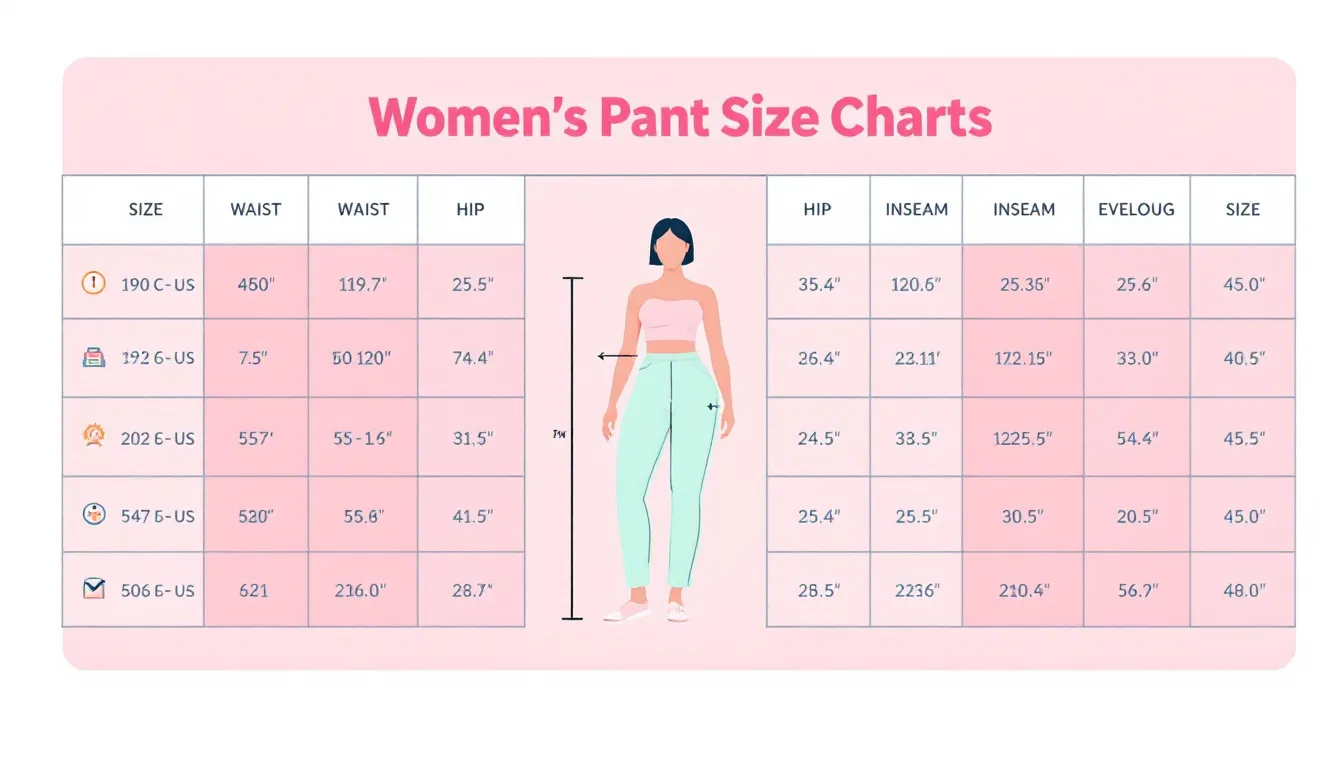
A waist and hip chart can help you find a starting size before shopping. The table below gives a broad example of measurements used in US women’s clothing charts. It is a general reference, not a universal sizing standard. Individual retailers may use different measurements for the same numbered size.
Measure your body first, then compare your numbers with the exact chart for the pants you want. If your waist matches one size and your hips match another, consider the garment’s cut and the brand’s fit advice rather than choosing by waist alone.
Source: data.templateroller.com
Use the chart as a guide
The ranges below are approximate examples compiled to show how measurements can increase across sizes. They are not official national averages or a replacement for a retailer’s chart.
Approximate US Women’s Pants Measurement Reference
The ranges below illustrate common body measurement ranges seen in retail size charts. They are rounded for easy comparison. Different brands may place the same waist or hip measurement in a different size category.
US 0 to 2
A small numeric size may correspond to a waist around 24 to 27 inches and hips around 34 to 36 inches, depending on the brand.
US 4 to 6
These sizes may cover a waist around 27 to 29 inches and hips around 36 to 38 inches in some charts.
US 8 to 10
Some brands place these sizes near a 29 to 31 inch waist and 38 to 41 inch hips.
US 12 to 14
These sizes may cover a waist around 31 to 34 inches and hips around 40 to 43 inches.
US 16 to 18
Some standard ranges place these sizes near a 34 to 40 inch waist and 43 to 49 inch hips, though other charts use different ranges.
US 20 and above
Larger sizes have wide variation across brands and size systems. Check the specific chart, including any women’s plus-size measurements.
Why Are the Ranges Not Exact?
Retailers create size charts for their own garments and target fits. One chart may give a size 10 a waist range of 29 to 31 inches. Another may use a different waist range or account for the hip measurement in another way. Neither label alone tells the whole story.
The type of pants matters as well. Stretch jeans, dress pants, leggings, wide-leg trousers, and low-rise pants do not sit on the body in the same way. A chart intended for leggings may not be the best guide for rigid denim or tailored trousers.
Fabric
Stretch fabric may allow more movement, while rigid fabric needs a closer match to the garment’s intended fit.
Rise
High-rise, mid-rise, and low-rise pants sit at different points on the torso, which changes how the waistband feels.
Cut
Slim, straight, relaxed, and wide-leg pants have different amounts of room through the seat and legs.
How to Measure Your Pant Size at Home
You can measure for pants at home with a soft tape measure and a mirror. Take the measurements over light clothing or directly over the body. Stand in a relaxed position, keep the tape level, and avoid pulling it so tight that it presses into your skin.
Record each measurement in inches. Repeat any measurement that seems unusual. If you plan to buy pants online, these numbers can help you compare the size chart with your body rather than guessing from the label of an older pair.
Source: sizechartwomen.com
What you need
A flexible measuring tape, a mirror, a note app or paper, and the size chart for your chosen brand.
Step 1: Measure Your Waist
Find the part of your waist where your body naturally bends when you lean to one side. Wrap the tape around that area and keep it parallel to the floor. Breathe normally and leave the tape snug without squeezing your body.
Do not assume your natural waist is the same place where every pair of pants sits. A low-rise waistband may rest below it, while a high-rise pair may reach closer to it. Use the retailer’s measuring directions if it gives a specific waistband location.
Good measurement
The tape stays level, touches the body gently, and does not dig into the skin.
Step 2: Measure Your Hips
Stand with your feet close together. Wrap the tape around the fullest part of your hips and seat. Check the mirror to make sure the tape stays level all the way around.
This measurement is useful because pants must fit over the hips and seat as well as the waist. If the hips are fuller than the waist, a pair chosen only by waist size may pull, wrinkle, or feel tight when you sit.
Avoid a common error
Do not measure only around the hip bones if the fullest part of your seat is lower down.
Step 3: Measure Your Inseam
The inseam is the length along the inside of the leg, from the crotch seam to the bottom of the leg. One easy method is to measure a pair of pants that already fits well. Lay the pants flat and measure the inside seam from the crotch to the hem.
Your ideal inseam depends on the cut and how you want the pants to fall. An ankle pant should be shorter than a full-length trouser. Shoes also affect where the hem looks right, especially with wide-leg pants.
Regular length
Often designed for a brand’s standard height range, but the exact inseam varies.
Short or petite length
Usually has a shorter leg length and may also use adjusted proportions.
Tall length
Usually provides more length through the leg and may adjust other proportions.
Step 4: Compare Your Measurements With the Size Chart
Open the size chart for the exact item, not just the retailer’s general clothing page. Check whether the numbers refer to body measurements or the garment itself. Body measurements describe the person the item is intended to fit, while garment measurements describe the pants after they are made.
If your waist fits one size and your hips fit another, read the retailer’s advice for that cut. For fitted pants, the larger measurement may be the better starting point, but the best choice still depends on stretch, rise, and how much ease the garment includes.
Before ordering
Check waist, hip, inseam, fabric stretch, rise, and the retailer’s return policy.
Why the Same Pant Size Fits Differently Across Brands
Two pairs with the same size label can feel very different because US women’s clothing sizes are not fully standardized across brands. Each company develops its own patterns, fit goals, and size charts. The fabric and shape of the pants add more variation.
This is why buying your usual size without checking the chart can lead to a poor fit. A size 10 in a stretch jean may feel comfortable, while a size 10 in a firm cotton trouser may feel snug. Neither result means your body measurement has changed.
Source: incheschart.com
Vanity sizing
Some brands use smaller size labels for garments that fit larger measurements than the same label in another brand. The term describes a sizing practice, not a reliable conversion rule.
Fabric stretch
Denim with elastane may give more than rigid denim. Check the fabric details before deciding whether to size down.
Rise and waistband shape
A curved waistband, high rise, or low rise can change where pressure or gaps appear.
Body proportions
Two people with the same waist measurement may have different hip, seat, thigh, or torso proportions.
Garment design
Tailored trousers, cargo pants, leggings, and relaxed jeans are built for different shapes and amounts of ease.
Should You Size Up or Size Down?
Do not size up or down based on a general rule about your usual size. Compare your measurements with the product chart first. Then look at the fabric and the fit notes, if the retailer provides them.
If a waistband digs in or the hips pull when you sit, the pants may be too small or the cut may not suit your proportions. If the waistband slips or excess fabric bunches around the seat, the pants may be too large or the rise may not match your body. A different cut can solve a fit issue that a different size cannot.
For rigid denim
Pay close attention to waist and hip measurements because the fabric has limited stretch.
For stretch pants
Follow the brand’s chart and avoid sizing down unless the brand specifically advises it.
For tailored trousers
Choose a fit that allows comfortable movement and check whether the waist or hem can be altered.
How to Tell Whether Your Pants Fit Well
A good fit is one that feels comfortable and suits the way you plan to wear the pants. The waistband should stay in place without pinching. The seat and thighs should allow you to sit and walk without strong pulling or unwanted gaps.
Try on pants while standing, sitting, and bending your knees. Check the front rise, back rise, and hem. A pair that looks fine while standing still may feel restrictive when you sit at a desk or get into a car.
Source: i.pinimg.com
Check the waistband
It should stay in place without digging in or needing constant adjustment.
Check the seat
Look for strong horizontal pull lines, strained seams, or excess fabric that affects the fit.
Check the thighs
You should be able to walk and sit without uncomfortable pressure or restricted movement.
Check the length
Make sure the hem works with the shoes you expect to wear and the style of the pants.
Check the fabric
Move around to see whether the fabric stretches, stays in place, or becomes uncomfortable.
Common Signs That You Need a Different Size or Cut
A tight waistband, pulling across the hips, or seams under strain can signal that the pants are too small or have the wrong shape for your body. A loose waistband, a slipping seat, or excess fabric can signal that they are too large or that the rise and cut are not right.
The solution is not always a new size. If the waist fits but the hips feel tight, a different cut may work better. If the hips fit but the waist gaps, look for a contoured waistband or a style made for a greater difference between waist and hip measurements.
Waist gap
Try a curved waistband, a different rise, or a cut designed to fit fuller hips.
Tight hips
Compare hip measurements and consider a roomier cut rather than forcing the current size.
Long hem
Look for short or petite lengths, or consider hemming if the rest of the fit is right.
Does the Average Pant Size Change With Age or Body Shape?
Age, body shape, and personal proportions can affect which pants fit well, but they do not determine one fixed clothing size. Women of the same age may have very different waist, hip, thigh, and inseam measurements. A population average cannot predict the best size for an individual.
Body measurements may also change over time. Weight changes, pregnancy, aging, activity, and other factors can affect the waist or hips. Clothing fit may change even when a person’s height stays the same. These changes are normal, and a size label is not a measure of health or personal worth.
Body shape can help explain why a size chart works well for one person but not another. Someone with a smaller waist and fuller hips may need a different cut from someone with straighter proportions, even if both have similar hip measurements. Brands that offer curvy, straight, petite, tall, or plus-size cuts may provide more useful options.
Source: images.surferseo.art
Curvy cuts
May provide more room through the hips and seat relative to the waist.
Straight cuts
May suit people who prefer less difference between the waist and hip fit.
Petite cuts
Often adjust the leg length and other proportions for shorter frames.
Tall cuts
Often add leg length and may adjust rise or other garment proportions.
Plus-size cuts
May use separate patterns to provide room and proportions suited to the size range.
Is a Larger Pant Size a Sign of Poor Health?
No. A clothing size alone cannot tell you whether someone is healthy. Retail sizes are inconsistent, and a label does not provide enough information to assess health, fitness, or body composition.
If your goal is to understand your health, clothing size is not a substitute for suitable medical advice or a full assessment. For shopping, focus on comfort, fit, and the measurements that help you choose clothes that work for you.
Keep size in context
Use clothing labels for shopping, not as a judgment of health or worth.
How to Choose Pants When Shopping Online in the US
Online shopping works best when you compare measurements instead of relying on a familiar label. Product photos can show the style, but they cannot tell you exactly how the waistband, seat, or thighs will fit your body. A clear size chart and a few checks can reduce guesswork.
Start with the retailer’s chart for the exact item. Check whether the measurements describe the body or the finished garment. Then review the fabric composition, rise, inseam, and any notes about whether the pants run small, large, or true to the brand’s usual sizing.
Source: i.etsystatic.com
Read the item details
Look for fabric stretch, rise, leg shape, and available lengths.
Compare all key measurements
Use waist, hips, and inseam rather than relying on one number.
Check the return rules
Confirm the deadline, condition requirements, and any return shipping cost before ordering.
Read reviews with care
Comments about fit can help, but body proportions and personal fit preferences vary.
Keep your measurements handy
Save your current measurements so you can compare them with new charts and update them when needed.
What If You Fall Between Two Sizes?
When your measurements fall between two sizes, use the product’s fit notes and the fabric to decide which one to try. For a non-stretch fabric, the larger size may offer more room to move. For stretch fabric, the brand’s guidance can help you decide whether the smaller size will fit as intended.
If your waist and hips point to different sizes, do not assume you must choose the smaller one to get a neat fit. Check which measurement is more important for the garment’s cut. You may get a better result from a curvy cut, a different rise, or a style with more room through the seat.
When comfort comes first
Choose a fit that allows you to sit, bend, and walk without strain.
When the waist is the problem
Consider a different waistband shape or a minor alteration if the rest of the pants fit well.
What the Available Evidence Can and Cannot Tell Us
The available research helps correct the idea that one small clothing size represents every American woman. The 2017 academic study compared national body measurement data from 1988 through 2010 with ASTM International misses and women’s plus-size clothing standards. Its estimate reflects the standards and survey data examined at that time.
Mys Tyler’s US report used data from more than 42,000 women in its community collected between 2020 and 2024. It reported an average dress size of 14 and a most common dress size of 16. Its larger sample offers useful information, but a community dataset may not represent every adult woman in the United States.
Neither source provides a definitive, current average pants size for the whole country. The first estimates clothing size by comparing body measurements with standards. The second reports dress sizes from a particular community. Pants can fit differently from dresses because of waistband position, hip shape, fabric, rise, and cut.
A reliable claim about the exact average US pant size would require a clearly defined and representative sample, a stated method for measuring pants size, and a consistent size system. Without those details, giving one number as a proven national average would suggest more certainty than the evidence supports.
Source: incheschart.com
Documented finding
The 2017 study estimated average American women’s clothing size using national body measurement data and published clothing standards.
Separate reported finding
Mys Tyler reported an average dress size of 14 within its US community dataset.
Not established
Neither result proves one exact average pant size for all women in the US today.
Why This Matters When You Buy Clothes
A national average may be useful for understanding clothing markets, but it cannot tell you which size to order. Your own measurements and the retailer’s size chart are more useful for that task. They also help you compare styles within the same brand.
The best approach is simple: measure your waist, hips, and inseam, check the chart for the item, and choose the fit that feels right. If one brand’s size does not match another’s, trust the measurements rather than assuming your body must fit a certain label.
For a quick answer
Treat published average clothing sizes as estimates, not a required or ideal size.
For a better fit
Use your own measurements and the brand’s exact chart before buying.
Frequently Asked Questions
Q
What is the average pant size for women in the US?
There is no single official average pant size for American women. A 2017 study estimated an average clothing size of misses 16 to 18 by comparing national body measurements with clothing standards. A separate report from Mys Tyler found an average dress size of 14 in its US community dataset. These findings use different methods and do not establish one exact average pant size.
Q
Is a size 14 considered average for American women?
Size 14 is a useful reference point in some reports, but it is not a universal average for pants. Mys Tyler reported size 14 as the average dress size in its community dataset. The academic study published in 2017 estimated a larger average clothing size using a different method. Retail sizing also varies from brand to brand.
Q
What waist measurement is a US women’s size 10?
A US women’s size 10 may correspond to a waist around 29 to 31 inches in some retail charts, but the exact range varies. Check the size guide for the brand and style you want. Hip measurements matter too, especially for fitted jeans and trousers.
Q
Do all US clothing brands use the same pant sizes?
No. US clothing brands set their own size charts and may use different patterns, fits, and fabric choices. A size 10 in one store can fit differently from a size 10 elsewhere. Compare your waist, hip, and inseam measurements with the exact product chart.
Q
How can I find my correct women’s pant size?
Measure your natural waist, the fullest part of your hips, and your inseam. Compare those numbers with the retailer’s chart and check whether it lists body or garment measurements. Then consider the fabric, rise, cut, and desired length. Try sitting and walking in the pants to check comfort if you can.
Q
Is women’s pants size the same as jeans size?
Not always. Some jeans use numeric US sizes, while others show waist and inseam measurements. Women’s trousers may use the same numeric labels but follow a different chart. Always check the sizing system used for the exact item.
Q
Should I buy a larger size if my hips are wider than my waist?
Not automatically. Compare both measurements with the brand’s chart and look for a cut that suits your proportions. Curvy styles or pants with a shaped waistband may fit better when there is a larger difference between waist and hip measurements. The best choice is the one that fits comfortably without pulling or slipping.
✦ Wrapping Up
Conclusion
The average pant size for women in the US is not one settled number. Published findings include an estimate of misses size 16 to 18 from an academic study and an average dress size of 14 from a separate community dataset. Those figures provide context, but they measure different things and should not be presented as an exact average pant size for all American women.
For a useful fit, focus on your own measurements instead of the size label. Waist, hip, and inseam measurements give you a stronger starting point. The brand’s chart, fabric, rise, and cut then help you narrow the choice. A comfortable pair of pants should fit your body, not force your body to fit a number.
💡 Key Takeaway
Measure your waist, hips, and inseam today. Save the numbers, compare them with the exact US size chart for your next pair of pants, and check the fit notes before ordering.